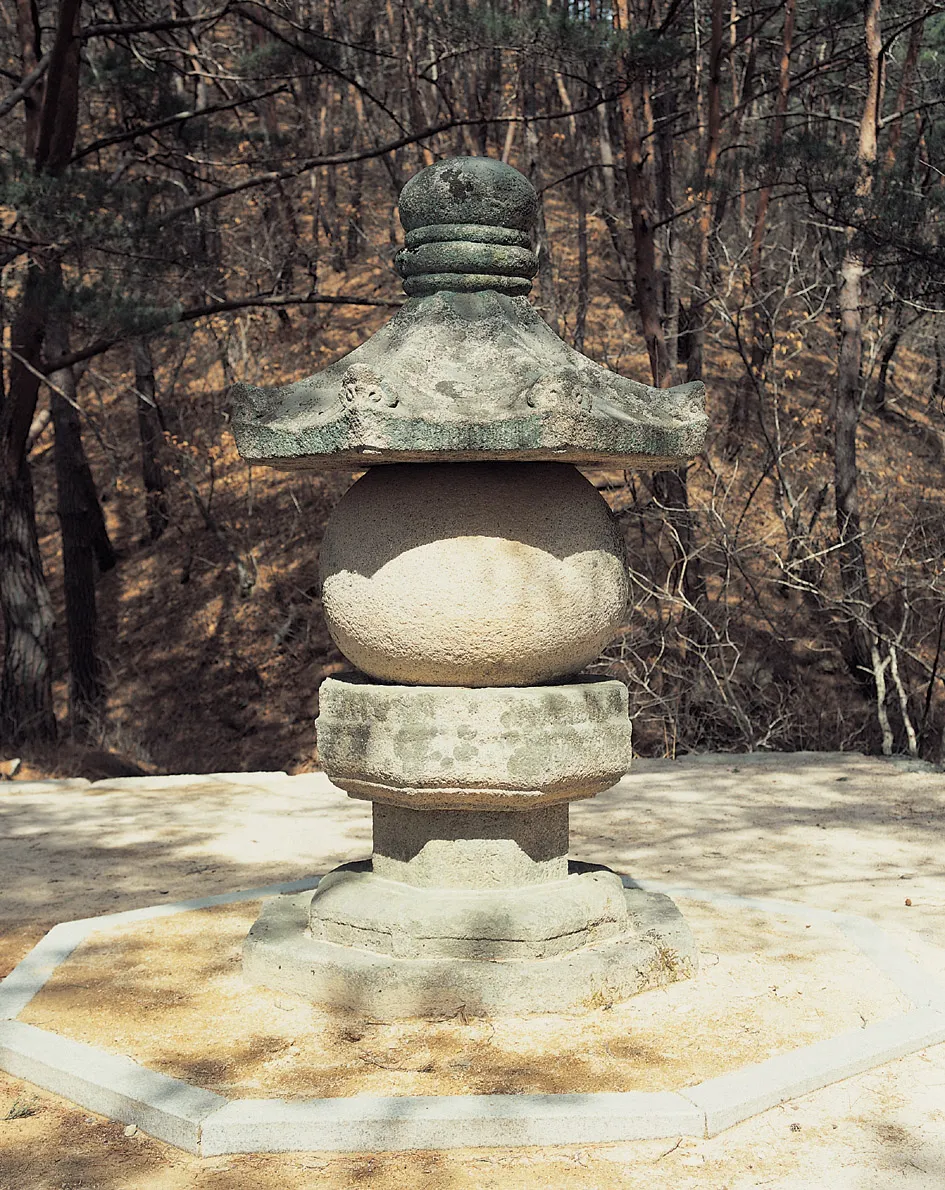
Beopjusa Bokcheonam Hakjohwasangtap, Boeun
報恩 法住寺 福泉庵 學祖和尙塔
충청북도 보은군
Basic information
- Designation
- Treasure No.1418
- Category
- Sites & Pagodas
- Era
- 조선시대(중종9년(1514))
- Designated year
- 2004
- Location
- 보은군, 충청북도— 충북 보은군 속리산면 법주사로 658-138 (사내리)
- Coordinates
- 36.550314, 127.854453
AI Docent
Coming soonAn AI-generated, friendly retelling of this heritage site is available in Korean. An English version is on our roadmap — for now, please see the official description below.
Description
This stupa is erected on hilly terrain, southeast of Bokcheonam Hermitage at Beopjusa Temple. The stupa is historically significant in that it is a stupa from the early Joseon Dynasty with an inscription of the name of the person to whom the stupa is dedicated and the construction date. Although the overall structural style of the stupa is similar to the octagonal stupas of the Goryeo Dynasty, its round body sets it apart. The words “Erected in the 5th month of the 9th year of Emperor Zhengde of the Ming Dynasty” and “Stupa of Hakjo Deunggok Hwasang” are inscribed on the octagonal middle pedestal, indicating that the stupa was erected in 1514 (the 9th year of the reign of King Jungjong of the Joseon Dynasty). Buddhist Monk Hakjo was a high priest in the early Joseon Dynasty who restored Haeinsa Temple under orders from Queen Insu in 1488 (the 19th year of the reign of King Seongjong); and published three volumes of the Goryeo Tripitaka of Haeinsa Temple and wrote the epilogues at the command of Queen Sin in 1500 (the 6th year of the reign of King Yeonsangun). On the whole, it is difficult to date the stupas of the Joseon Dynasty as there aren’t many monuments to refer to from that period. In this respect, this stupa is valuable in that the construction date and the name of the person to whom the stupa is dedicated are clearly inscribed, and because it exhibits the characteristics of stupas of the early Joseon Dynasty that followed in the style of stupas of the Goryeo Dynasty. As such, it is considered a prototype and reference for other stupas of the Joseon Dynasty.
Location
지도를 불러오는 중…
Have you visited this place?
Log in and verify your visit on-site via GPS to record a stamp in My Journey. (QR verification coming later.)
Images: KOGL (khs.go.kr) · Data source: Korea Heritage Service Open API (khs.go.kr)