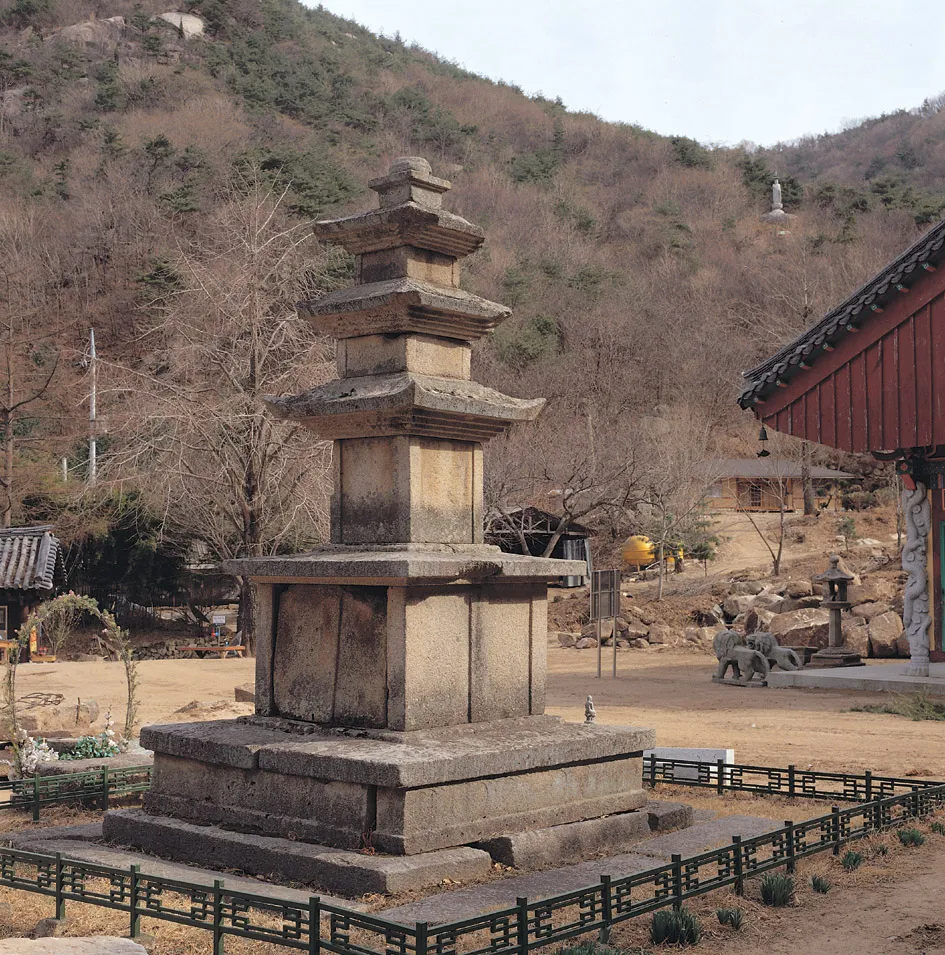
Three-story Stone Pagoda of Bulgulsa Temple, Gyeongsan
慶山 佛窟寺 三層石塔
경상북도 경산시
Basic information
- Designation
- Treasure No.429
- Category
- Sites & Pagodas
- Era
- 통일신라시대
- Designated year
- 1965
- Location
- 경산시, 경상북도— 경상북도 경산시 불굴사길 205(와촌면, 불굴사)
- Coordinates
- 35.945194, 128.778819
AI Docent
Coming soonAn AI-generated, friendly retelling of this heritage site is available in Korean. An English version is on our roadmap — for now, please see the official description below.
Description
This three-story stone pagoda situated in front of the Buddhist sanctuary at Bulgulsa Temple was built in 690 (the 10th year of the reign of King Sinmun of the Silla Dynasty). It is said that it was a huge temple consisting of about fifty buildings and twelve hermitages up until the mid-Joseon period. The pagoda is composed of a two-layered stylobate and a three-story main body in the typical style of stone pagodas of the Silla Dynasty. The pagoda has a large long stone for the foundation. The four faces of the bottom layer of the stylobate are hewn from four pieces of stone. The top stone of the bottom layer of the stylobate is relatively thick and is supported by two-tiered stones. The middle stone of the top layer of the stylobate is engraved with pillar patterns at its corners and at the center of each face. Although the top stone of the stylobate is thin, there is another stone plate aligned with the top stone under it. The core and roof stones of the main body are each hewn from a single stone. All the corners of the core stones are engraved solely with pillar patterns. The number of the cornices of the roof stones taper four-tiered for every story upward. The eaves are horizontal but turn sharply upward at the edges; while the four corners of the roof stones slope gently but turn considerably upward at the ends. Of the upper part of the pagoda, the finial base and finial, which resembles an over-turned bowl, remain intact. This three-story stone pagoda is admired for its beautiful composition, well-measured stone finishing and well-proportioned structure. However, given that the pagoda is relatively small; the roof stones turn considerably upward at the ends; and the supporting stones carved under each part of the pagoda are distinctive, it is likely that the pagoda was erected during the late Unified Silla period.
Location
지도를 불러오는 중…
Have you visited this place?
Log in and verify your visit on-site via GPS to record a stamp in My Journey. (QR verification coming later.)
Images: KOGL (khs.go.kr) · Data source: Korea Heritage Service Open API (khs.go.kr)