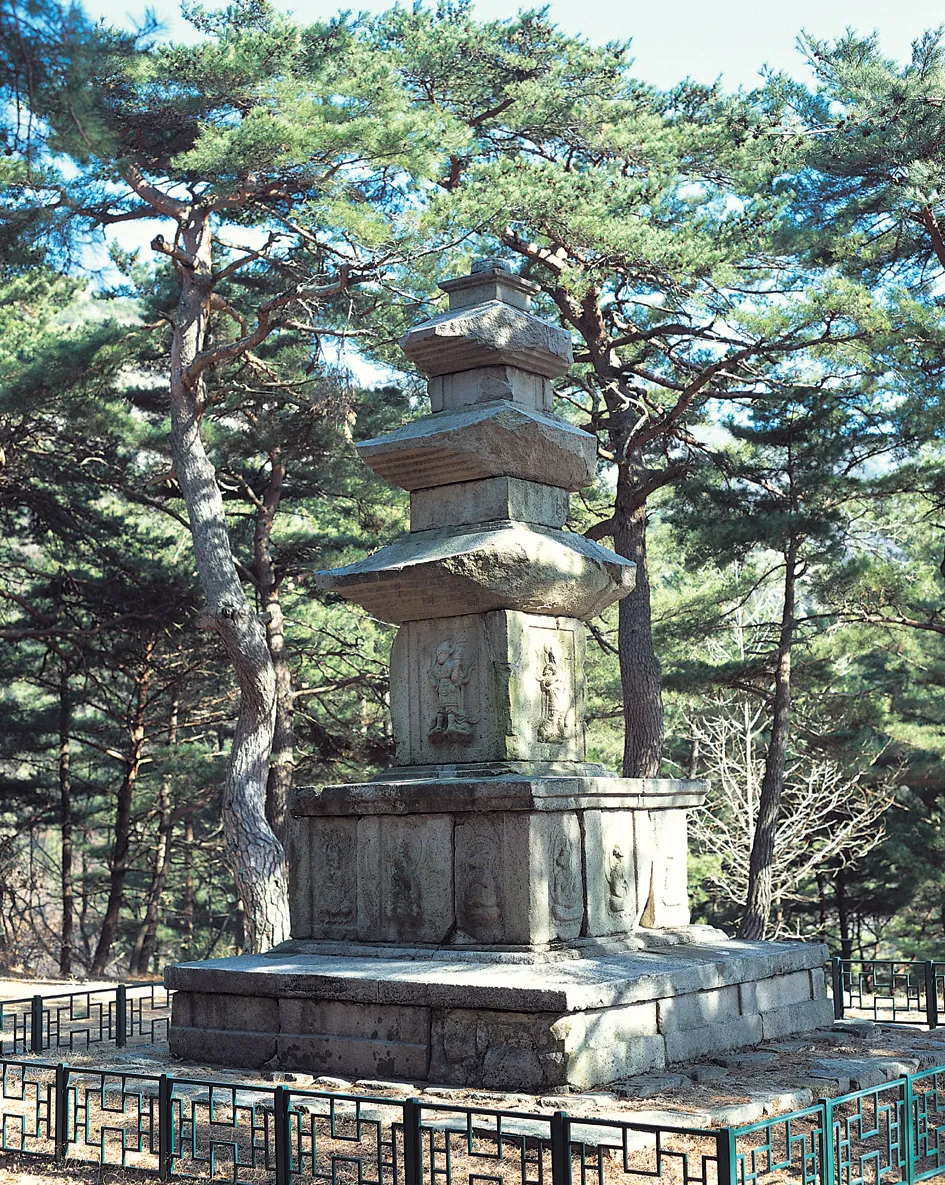
Wonwonsaji Dong·seo Three-story Stone Pagoda, Gyeongju
慶州 遠願寺址 東·西 三層石塔
경상북도 경주시
Basic information
- Designation
- Treasure No.1429
- Category
- Sites & Pagodas
- Era
- 통일신라시대(8세기 중기)
- Designated year
- 2005
- Location
- 경주시, 경상북도— 경북 경주시 외동읍 모화리 산12-3번지
- Coordinates
- 35.697830, 129.349796
AI Docent
Coming soonAn AI-generated, friendly retelling of this heritage site is available in Korean. An English version is on our roadmap — for now, please see the official description below.
Description
These twinned East and West Three-story Pagodas are located at the Wonwonsa Temple Site in Gyeongju (Historic Site No. 46). According to Samguk yusa (Memorabilia of the Three Kingdoms), Wonwonsa Temple was founded by Anhye and Nangyung, followers of esoteric Buddhism, together with Kim Yu-sin, Kim Ui-won and Kim Sul-jong, as a place to pray for national security. The east and west pagodas (approximately 7m high) were destroyed, and later restored by the Society for the Preservation of Historical Relics in Gyeongju in the autumn of 1931. The two pagodas are identical in structure and style, with a double-tiered stylobate and three-storied body. The lower-tier of the stylobate is composed of eight side stones and eight capstones, while the upper-tier is composed of eight side stones and four capstones. The side stones of the upper and lower-tier stylobate each has two middle and corner pillars. On top of the lower-tier capstone is a double-tiered support for the upper-tier stylobate. The figures of the Twelve Animal Deities of the Zodiac sitting on lotus pedestals are carved on all four sides of the upper-tier, in between the pillars. The figures have animal heads and human bodies, and are dressed in everyday attire, with their clothes blowing in the wind toward the heavens. Each part of the body of the pagoda, from the core stone of the first story to the roof stone of the third story, is hewn from a single slab of stone. The first story has four corner pillars, and figures of Four Guardian Kings clad in armor and holding weapons, are carved on all four sides. The roof stones of each story are supported by five-tiered roof supports. On top of each roof stone sit square double-tiered body supports. Only the finial base and the anghwa (upward-facing lotus ornament) remain of the pagoda’s finial. The twin pagoda’s sculptural styles, which are characteristic of stone pagodas of the Unified Silla Period, the cutting and trimming techniques of the roof stones, the artistic styles of the stylobate and the body, and the technique of piecing the stone blocks together all suggest that these pagodas were erected around the mid-8th century. These pagodas were the first to feature carved figures of the twelve animal deities of the Chinese zodiac on the stylobate. Its sculptural technique and expressive styles are valuable for the study of art history.
Location
지도를 불러오는 중…
Have you visited this place?
Log in and verify your visit on-site via GPS to record a stamp in My Journey. (QR verification coming later.)
Images: KOGL (khs.go.kr) · Data source: Korea Heritage Service Open API (khs.go.kr)