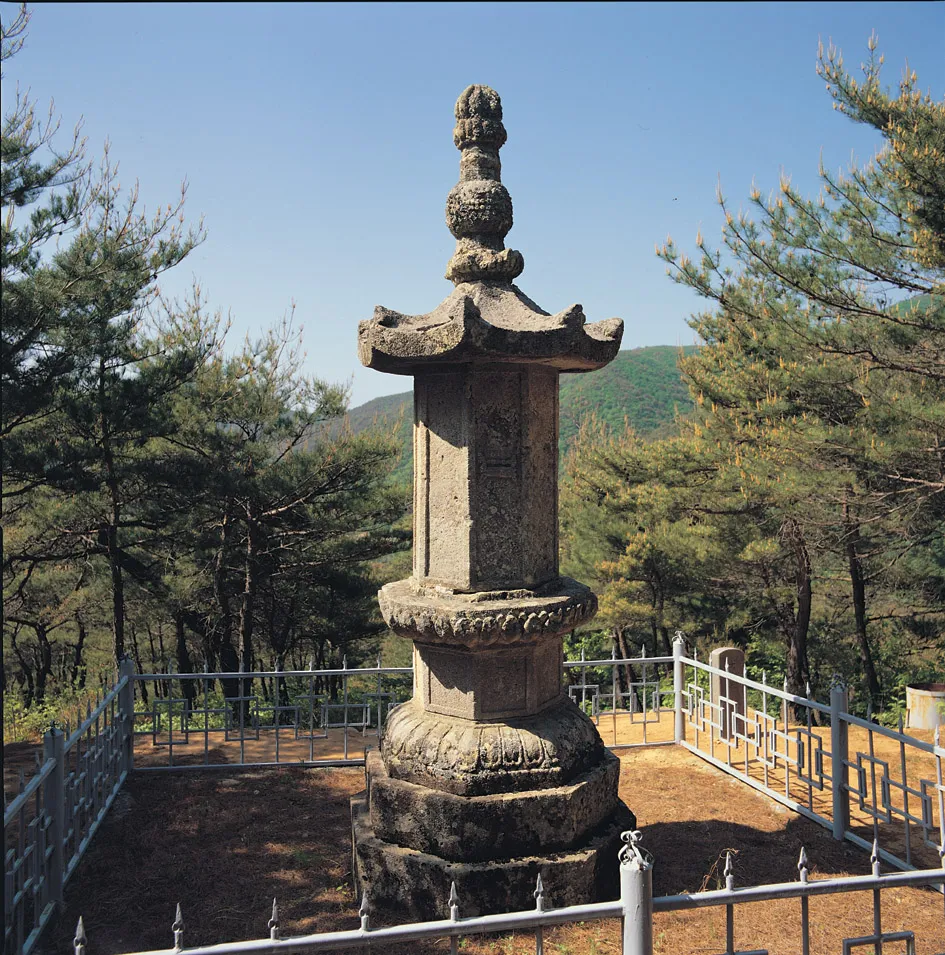
Stupa of Bogyeongsa Temple, Pohang
浦項 寶鏡寺 僧塔
경상북도 포항시
Basic information
- Designation
- Treasure No.430
- Category
- Sites & Pagodas
- Era
- 고려시대
- Designated year
- 1965
- Location
- 포항시, 경상북도— 경북 포항시 북구 송라면 보경로 533, 보경사 (중산리)
- Coordinates
- 36.254305, 129.318992
AI Docent
Coming soonAn AI-generated, friendly retelling of this heritage site is available in Korean. An English version is on our roadmap — for now, please see the official description below.
Description
The stupa, which enshrines the sarira of State Preceptor Wonjin, is located halfway up the mountain behind Bogyeongsa Temple in Pohang. Wonjin, whose birth name was Sin Seung-hyeong, was a Buddhist monk during the mid-Goryeo Dynasty. When he entered Nirvana at the age of 51, King Gojong appointed him as State Preceptor and granted him the posthumous title of Wonjin. The stylobate of the stupa consists of three-layered octagonal stones. The top part of the bottom layer is engraved with lotus flower patterns; every corner of the middle layer of the stylobate is engraved with pillar patterns; and the upper layer is embossed with lotus petal patterns whose sharp ends and vertical lines are carved in relief - something of a rarity during that period. The main body of the stupa, which resembles a stone pillar, is carved with a lock design on only one surface. The roof stone slopes gently and its eight corners are embossed with small flowers. The eaves turn swiftly upwards at each end of the roof stone and the ends of the eaves look thick Regarding the upper part of the stupa, the finial, which resembles an over-turned bowl, is placed on a supporting stone resembling a full-blown lotus flower. The large lotus bud is topped on the stone engraved with lotus flower patterns. Regarding the upper part of the stupa, the finial consisting of bokbal, which resembles an over-turned bowl, and the supporting stone engraved with lotus flower patterns, and boju (ornamental top resembling the large lotus bud) on the top. In general, the finial is well preserved and has retained its original appearance. The stupa was erected in the general style of octagonal stupas, but it seems disproportionately long, with a tall main body and narrow width, giving it an unstable appearance. It exhibits a plain and simple style characterized by a lack of delicately-expressed carving.
Location
지도를 불러오는 중…
Have you visited this place?
Log in and verify your visit on-site via GPS to record a stamp in My Journey. (QR verification coming later.)
Images: KOGL (khs.go.kr) · Data source: Korea Heritage Service Open API (khs.go.kr)