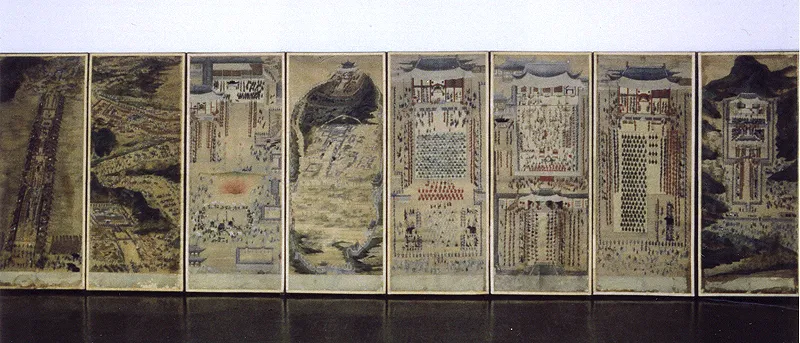
Hwaseonghaenghaengdo Folding Screen
華城行幸圖 屛風
서울특별시 용산구
Basic information
- Designation
- Treasure No.1430
- Category
- Painting
- Era
- 18세기
- Designated year
- 2005
- Location
- 용산구, 서울특별시— 서울 용산구 이태원로55길 60-16, 삼성미술관 리움 (한남동)
- Coordinates
- 37.538427, 126.965444
AI Docent
Coming soonAn AI-generated, friendly retelling of this heritage site is available in Korean. An English version is on our roadmap — for now, please see the official description below.
Description
This eight-panel folding screen depicts the major ceremonial events held during the eight-day procession led by King Jeongjo, accompanied by his mother, Lady Hyegyeong, to the ancestral tomb (Hyeollyungwon) in Hwaseong where his father, Crown Prince Sado, was buried. The procession, which took place on February 9, 1795 (the 19th year of the reign of King Jeongjo of the Joseon Dynasty) and lasted for eight days, was held to commemorate his late father’s 60th birthday. The eight scenes depicted from right to left comprise the visit to the Royal Ancestral Tomb at Hwaseong; the Special Civil and Military Service Examinations; a Banquet in Honor of the King’s Mother at Bongsudang Hall; a Feast for the Elders at Nangnamheon Pavilion; Nighttime Military Exercises at Seojangdae Fort; the King Shooting Arrows at Deukjungjeong Pavilion; the Procession Returning to the Royal Palace; and the Procession Crossing the Hangang River over a Pontoon Bridge. The work was produced by some of the period’s most eminent court artists from the Gyujanggak (Royal Library), including Kim Deuk-sin and Yi In-mun. The scene depicting the banquet held at Bongsudang Hall closely resembles the traditional composition of paintings of that time. However, the composition of the scene depicting the procession returning to the Royal Palace is in the shape of a ‘之,’ which is characteristic of Pyeongsaengdo (Lifetime Paintings) of the famous court painter Kim Hong-do. The last scene depicting the procession crossing the Hangang River over a pontoon bridge displays a unique composition rarely seen in paintings of royal processions at that time. Overall, the scenes portray subjects from all walks of life with a slightly comic touch, and faithfully reflect the customs and lives of the people of those times with the use of refined colors and sophisticated depiction. In this respect, the painting is, in essence, a historical documentary painting, although it also exhibits the characteristics of genre paintings, which are pictorial representations of everyday life. The painting is rendered in sophisticated, elegant colors, with each scene depicted with an exceptional attention to detail. It is not only a remarkable work of art, but also a work of great historical value that provides valuable insights into the customs and way of life of that time. The painting is a masterpiece among documentary paintings of the 18th century.
Location
지도를 불러오는 중…
Have you visited this place?
Log in and verify your visit on-site via GPS to record a stamp in My Journey. (QR verification coming later.)
Images: KOGL (khs.go.kr) · Data source: Korea Heritage Service Open API (khs.go.kr)