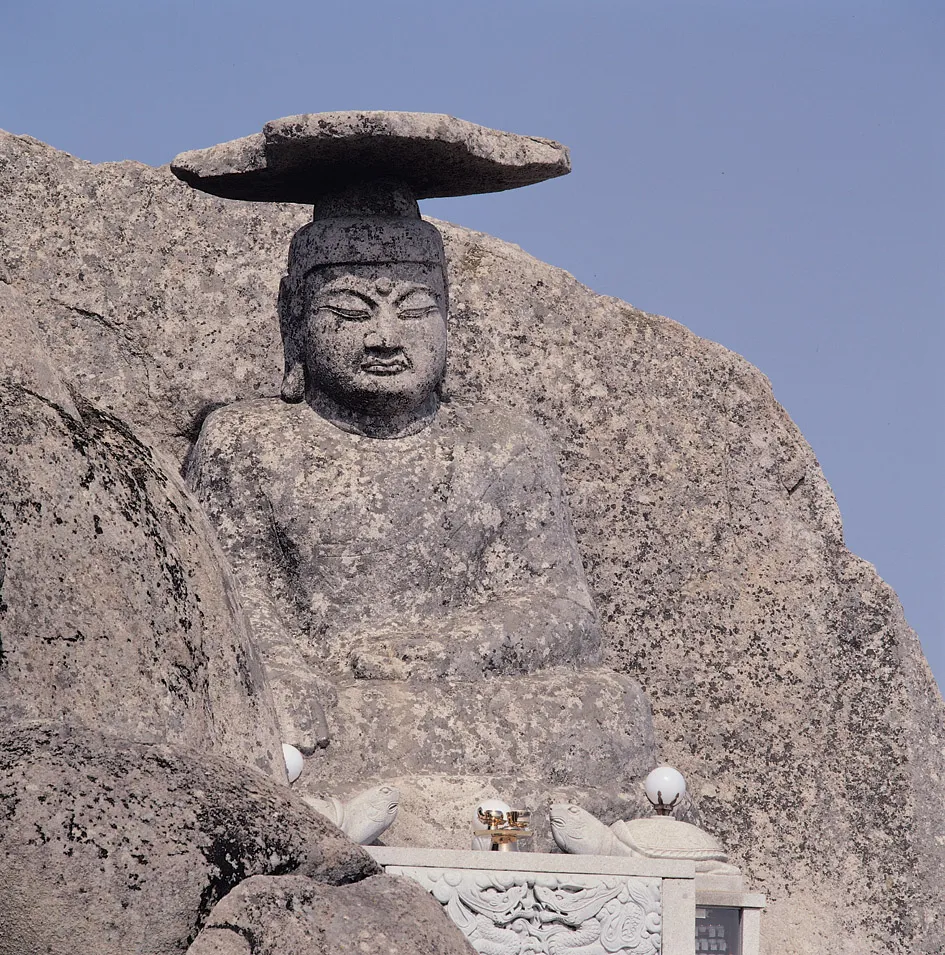
Stone Seated Buddha at Gwanbong Peak in Palgongsan Mountain, Gyeongsan
慶山 八公山 冠峰 石造如來坐像
경상북도 경산시
Basic information
- Designation
- Treasure No.431
- Category
- Sculpture
- Era
- 통일신라시대
- Designated year
- 1965
- Location
- 경산시, 경상북도— 경북 경산시 와촌면 갓바위로81길 176-64, 선본사 (대한리)
- Coordinates
- 35.981615, 128.735977
AI Docent
Coming soonAn AI-generated, friendly retelling of this heritage site is available in Korean. An English version is on our roadmap — for now, please see the official description below.
Description
This seated Buddha statue is located on the southern peak of Palgongsan Mountain, also called Gwanbong Peak, in Gyeongsan of Gyeongsangbuk-do. Gwanbong Peak is also known as Gatbawi (bamboo hat rock) because the wide stone plate on the Buddha’s head resembles a bamboo hat. The Buddha’s bald head is carved with a large usnisa (a protuberance on top of the head symbolizing supreme wisdom). He has a round plump face with eyes slanting slightly upward. The ears are long and hang down to the shoulders; and the samdo, i.e. the three wrinkles on the neck, can be seen on its thick and short neck. The broad square shoulders have a solid sturdy look about them; however, the chest is rather flat and the body seems heavy. The Buddha’s rustic-looking hands are placed on the knees, and the right hand is pointing downwards in the Bhumisparsa mudra, i.e. a gesture representing the repulsion of evil spirits, which is similar to the hand gesture of the principal image of Buddha at Seokguram Grotto. However, it is holding a small medicine bottle in its left hand, which confirms that it is the Bhaisajyaguru (Healing) Buddha. The hem of the clothing at the front and sides covers the square pedestal. The stonewall, which acts as a folding screen behind the Buddha statue, serves as the Buddha’s mandorla (halo of light), although it is entirely separate from the statue. The plump but still face, formal folds, and flat rigid-looking body are characteristic features of Buddha statues made during the ninth century, clearly distinguishing them from statues of the eighth century.
Location
지도를 불러오는 중…
Have you visited this place?
Log in and verify your visit on-site via GPS to record a stamp in My Journey. (QR verification coming later.)
Images: KOGL (khs.go.kr) · Data source: Korea Heritage Service Open API (khs.go.kr)