Jeokcheonsa Gwaebultaeng Mit Jiju
磧川寺 掛佛幀 및 支柱
경상북도 청도군
Basic information
- Designation
- Treasure No.1432
- Category
- Painting
- Era
- 괘불탱:1695년,지주:1701년
- Designated year
- 2005
- Location
- 청도군, 경상북도— 경상북도 청도군 원동길 304 (청도읍, 적천사)
- Coordinates
- 35.613193, 128.737673Kakao address conversion
AI Docent
Coming soonAn AI-generated, friendly retelling of this heritage site is available in Korean. An English version is on our roadmap — for now, please see the official description below.
Description
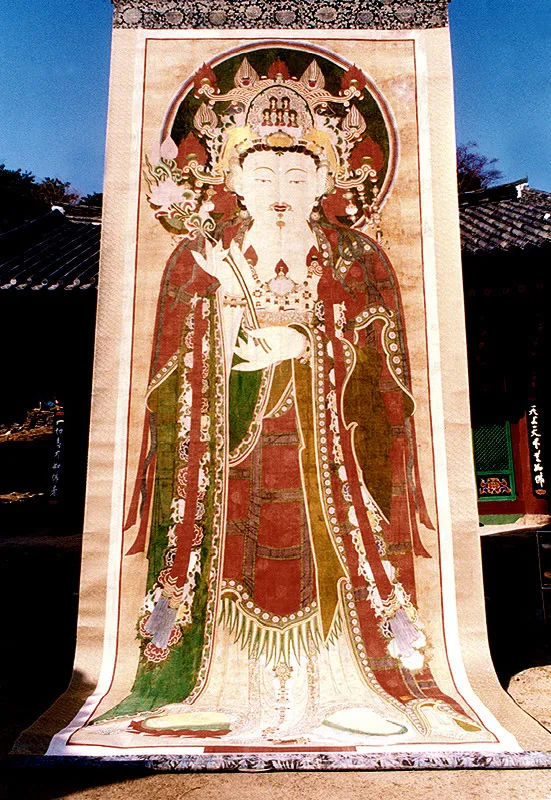
This hanging Buddhist painting, enshrined in Jeokcheonsa Temple, is in the style of a dokjondo (painting of a single Buddhist figure). It is simple in composition, consisting of no more than the main Bodhisattva standing alone, with no other figures or scenery depicted in the background. The Bodhisattva is wearing a large jeweled crown, and holds a lotus flower over his right shoulder. Five hwabul (incarnations of Buddha) are depicted in the center of the crown, with two phoenixes decorated in gold leaf to the right and left. The large crown on the head and the Bodhisattva’s broad shoulders convey a heavy feeling, but the oval face and small features add a touch of elegance. The predominant colors used in the painting are scarlet and green, together with soft pink, light blue and lime-green, giving the picture a bright, vibrant tone along with the slim-looking oval face. According to the inscription at the bottom of the painting, it was produced in 1695 (the 34th year of the reign of King Kangxi of the Qing Dynasty, China) by court artists Sangnin, Haeung, Jiyeong, Seongjong and Sangmyeong. In addition, a pair of stone flagpole supports for hanging the Buddhist painting stand on the ground in front of Daeungjeon Hall. According to the inscription, the supports were erected in 1701 (the 40th year of the reign of King Kangxi) by Buddhist Monk Gyeongsun and others. Both the painting and the flagpole supports are invaluable materials for the study of Buddhist paintings and Buddhist flagpole supports during the late 17th century.
Location
지도를 불러오는 중…
Have you visited this place?
Log in and verify your visit on-site via GPS to record a stamp in My Journey. (QR verification coming later.)
Images: KOGL (khs.go.kr) · Data source: Korea Heritage Service Open API (khs.go.kr)