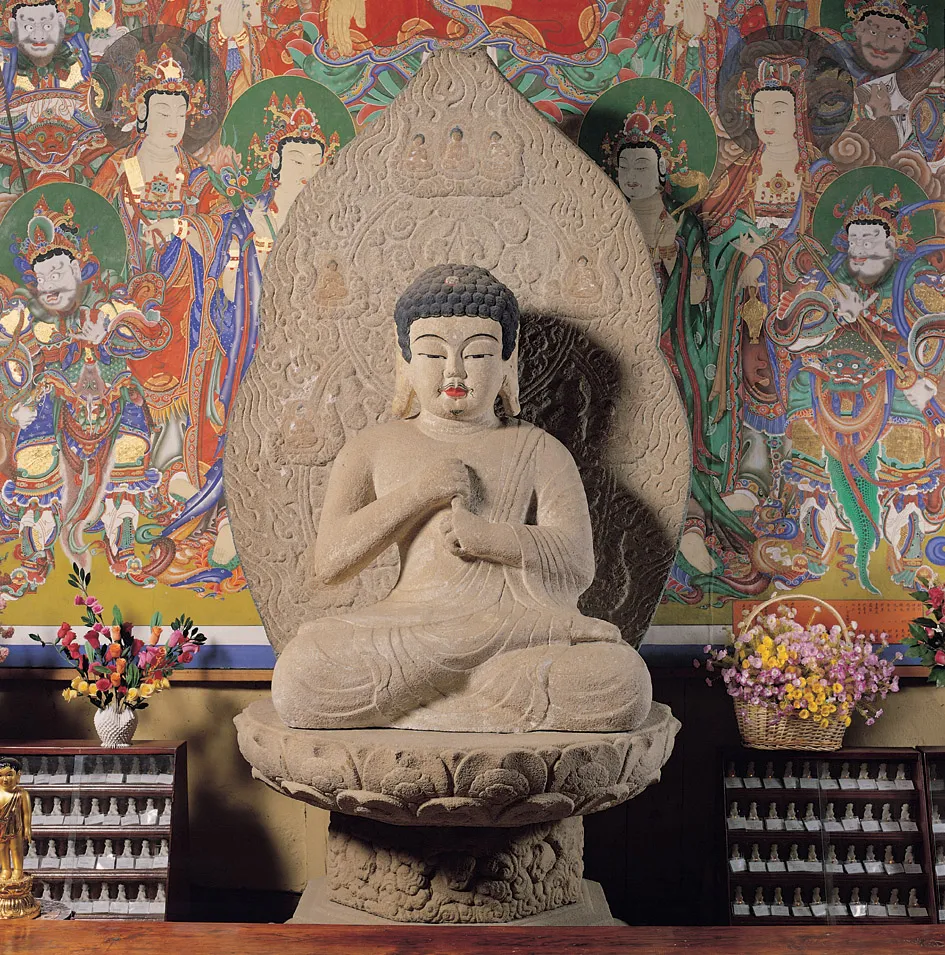
Stone Seated Vairocana Buddha of Gagyeonsa Temple, Goesan
槐山 覺淵寺 石造毘盧遮那佛坐像
충청북도 괴산군
Basic information
- Designation
- Treasure No.433
- Category
- Sculpture
- Era
- 통일신라시대
- Designated year
- 1966
- Location
- 괴산군, 충청북도— 충북 괴산군 칠성면 각연길 451, 각연사 (태성리)
- Coordinates
- 36.754742, 127.927691
AI Docent
Coming soonAn AI-generated, friendly retelling of this heritage site is available in Korean. An English version is on our roadmap — for now, please see the official description below.
Description
This Vairocana Buddha statue is complete with both its pedestal Buddha and mandorla (Buddhist halo of light), which expresses the light emanating from the Buddha’s body. Vairocana Buddha is regarded as a ruler of the world of truth. The Buddha’s hair is expressed in the curly nabal style (i.e. twirled up and around in a seashell-shaped fashion), and a flat usnisa (a protuberance symbolizing supreme wisdom) can be hardly seen on top of his head. The boobui (robe), which covers the left shoulder while leaving the right shoulder exposed, consists of simple folds expressed in an extremely formal way, especially around the legs. This feature, along with the facial expression, is very similar to the Iron Seated Vairocana Buddha of Janggoksa Temple, Cheongyang (Treasure No. 174). However, the awkward way in which the right hand holding the left index finger is expressed, and the exposed left side of the body give the statue an unfinished look. The water drop-shaped mandorla is slim at the middle, as if to distinguish the dugwang (light radiating from the head) behind the head from the singwang (light emanating from the body) behind the body. The upper part of the mandorla above the statue’s head and both sides of the statue are each engraved with three small Buddha images. The mandorla is generally engraved with lotus and cloud patterns, while its edge is decorated with flame patterns. Like typical Buddhist images made during the heyday of the Silla Period, the statue lacks tense vitality and elegant craftsmanship, but, as a piece dating from the late Unified Silla Dynasty, its overall appearance is rather graceful.
Location
지도를 불러오는 중…
Have you visited this place?
Log in and verify your visit on-site via GPS to record a stamp in My Journey. (QR verification coming later.)
Images: KOGL (khs.go.kr) · Data source: Korea Heritage Service Open API (khs.go.kr)