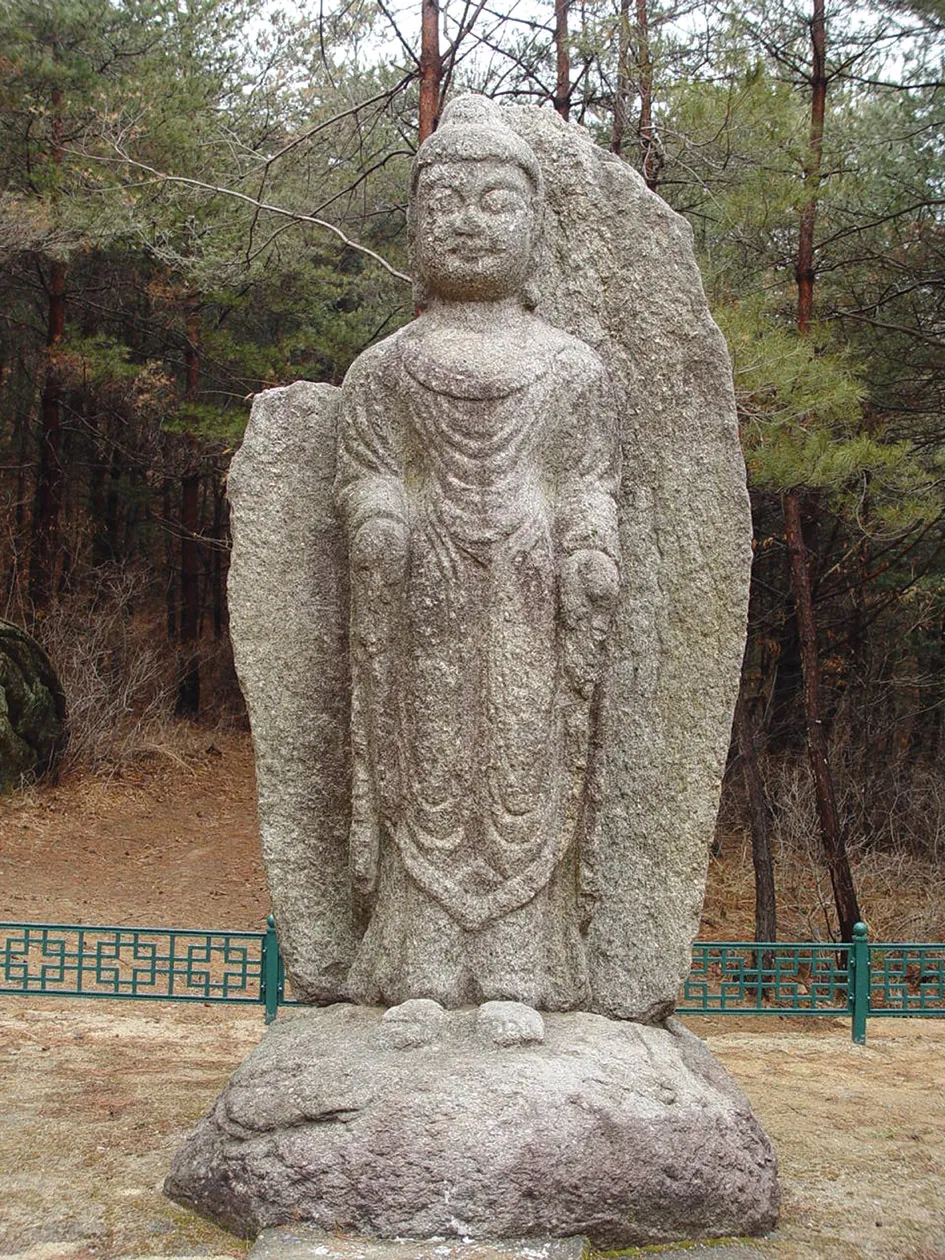
Nongsanri Stone Standing Buddha, Geochang
居昌 農山里 石造如來立像
경상남도 거창군
Basic information
- Designation
- Treasure No.1436
- Category
- Sculpture
- Era
- 통일신라시대
- Designated year
- 2005
- Location
- 거창군, 경상남도— 경남 거창군 북상면 농산리 산53번지
- Coordinates
- 35.769803, 127.813249
AI Docent
Coming soonAn AI-generated, friendly retelling of this heritage site is available in Korean. An English version is on our roadmap — for now, please see the official description below.
Description
This stone standing Buddha is located at the foot of a hill in Nongsan-ri, Geochang. It depicts the typical characteristics of Buddhist statues made during the Unified Silla Period. It is composed of two pieces of stone: one large piece on which are carved the figure’s two feet, and a second piece that sits on top of it and on which are carved the body and the mandorla of the Buddha. The face is large relative to the body, and although parts of it have been damaged, it displays a virtuous look. The figure is wearing a tonggyeon, a robe that covers both the shoulders, the folds of which are arranged in the King Udyana style, i.e. they form a U-shape at the chest and then part at the slender waist in a Y-shape, flowing down over both thighs in bilateral symmetry. These characteristics are also found in stone Buddhas produced after the 8th century, such as the Sandstone Standing Buddha (a cultural heritage of Gyeongju National Museum) presumed to have been made around the year 700 during the Unified Silla Period; the Stone Standing Buddha at Gamsansa Temple dated around 719; and the Stone Standing Buddha on the southern side of the Four Stone Buddhas at the Gulbulsa Temple Site in Gyeongju, which are presumed to have been made around 730-760. This suggests that this particular Stone Standing Buddha in Nongsan-ri was also made around that time. The figure’s two feet are carved on a stone, which is separate from the body stone, and the damage and abrasion are so severe that only the shapes of the toes of the left foot partially remain. The large boat-shaped mandorla surrounding the body and head retains most of its original shape apart from the top right section, which has been broken off, but the flame designs are not distinguishable. Although partially damaged, this stone standing Buddha is an invaluable piece of work in that it remains in its original location and is a rather large and rare example of its kind, as well as exhibiting sophisticated carving skills.
Location
지도를 불러오는 중…
Have you visited this place?
Log in and verify your visit on-site via GPS to record a stamp in My Journey. (QR verification coming later.)
Images: KOGL (khs.go.kr) · Data source: Korea Heritage Service Open API (khs.go.kr)