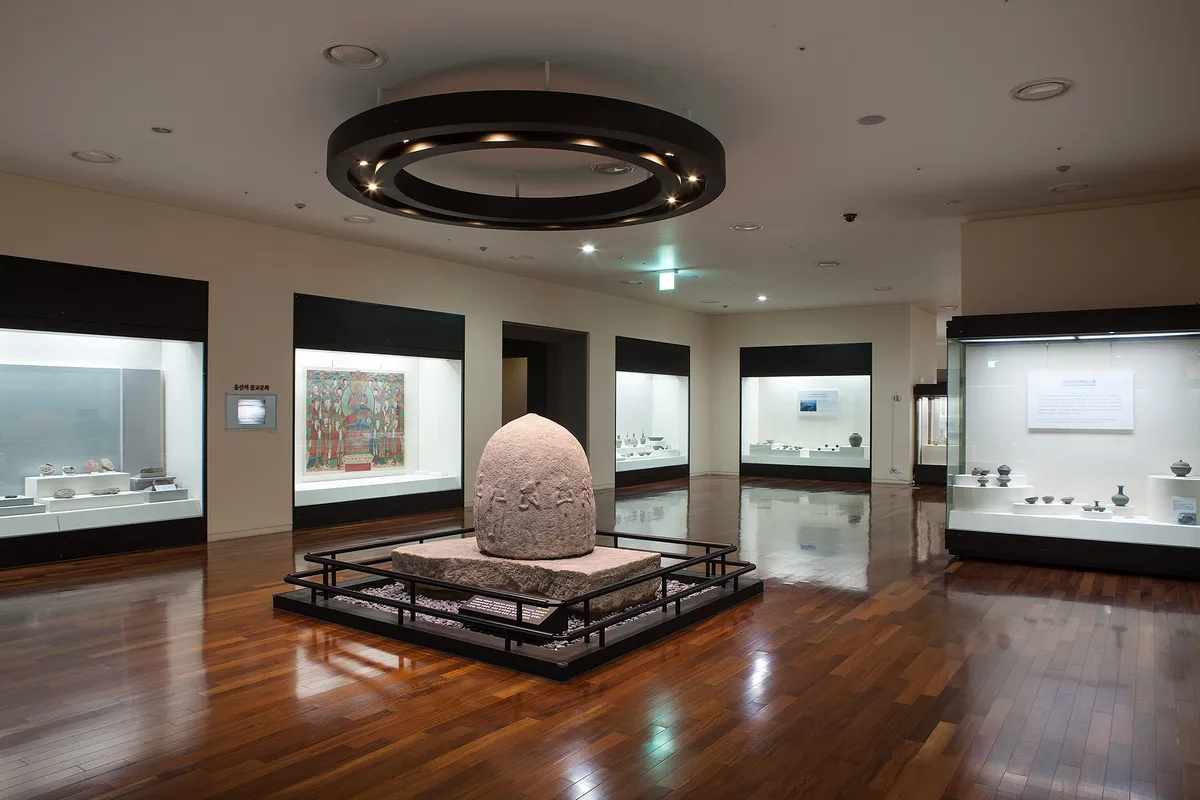
Stupa with Twelve Zodiac Animal Deities in Relief from Taehwasa Temple Site, Ulsan
蔚山 太和寺址 十二支像 舍利塔
울산광역시 남구
Basic information
- Designation
- Treasure No.441
- Category
- Sites & Pagodas
- Era
- 통일신라시대
- Designated year
- 1966
- Location
- 남구, 울산광역시— 울산광역시 남구 두왕로 277(신정동, 울산박물관)
- Coordinates
- 35.527223, 129.308661
AI Docent
Coming soonAn AI-generated, friendly retelling of this heritage site is available in Korean. An English version is on our roadmap — for now, please see the official description below.
Description
This stupa was unearthed at the former site of Taehwasa Temple* in 1962 and temporarily moved to Busan (the seat of the provincial government of Gyeongsangnam-do at that time), before being transferred to Hakseonggongwon Park in Ulsan. It has been preserved at Ulsan Museum since 2011. Unlike other stupas, it consists of a bell-shaped body placed on a broad base stone, which is engraved with panel decorations on its front and sides. The upper part of the main body is carved with an entrance to a niche (for housing a statue of the Buddha) in which a sarira is enshrined. The lower part of the body below the entrance of the niche is engraved in relief with the twelve deities of the Chinese zodiac, each of which consists of an animal’s head and a practically-naked human body. As standing figures of the twelve deities of the Chinese zodiac were usually erected to protect tombs during the Unified Silla period, this is a rare example of a stupa that is actually engraved with such figures. It could be interpreted to mean that the stupa was regarded as a tomb at that time and that these twelve deities were designed to protect the stupa. This is a valuable relic in that it is the oldest bell-shaped stupa. Judging from the style and carving techniques, it was probably made in the 9th century during the late Unified Silla period. *Taehwasa Temple was founded by Buddhist monk Jajang in 643 (the 12th year of the reign of Queen Seondeok of the Silla Dynasty). It is assumed that the temple was destroyed during serious attacks by Japanese pirates at the end of the Goryeo Dynasty. The stupa is the only surviving relic of the temple site.
Location
지도를 불러오는 중…
Have you visited this place?
Log in and verify your visit on-site via GPS to record a stamp in My Journey. (QR verification coming later.)
Images: KOGL (khs.go.kr) · Data source: Korea Heritage Service Open API (khs.go.kr)