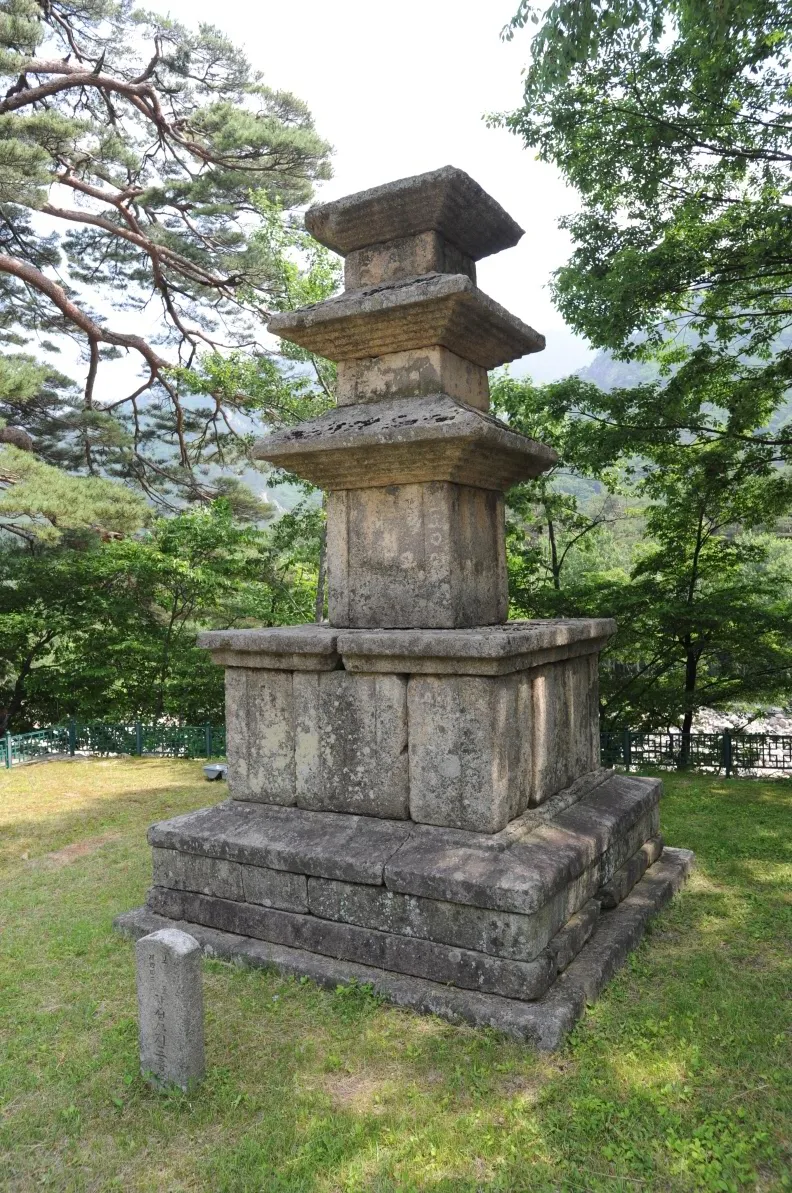
Three-story Stone Pagoda at Hyangseongsa Temple Site, Sokcho
束草 香城寺址 三層石塔
강원특별자치도 속초시
Basic information
- Designation
- Treasure No.443
- Category
- Sites & Pagodas
- Era
- 통일신라시대
- Designated year
- 1966
- Location
- 속초시, 강원특별자치도— 강원 속초시 설악동 산24-2번지
- Coordinates
- 38.172003, 128.499526
AI Docent
Coming soonAn AI-generated, friendly retelling of this heritage site is available in Korean. An English version is on our roadmap — for now, please see the official description below.
Description
This three-story stone pagoda is located near the entrance to Seorak-dong, between Sokcho and Seoraksan Mountain. The area is thought to have been the site of Hyangseongsa Temple Site, but it is impossible to determine the appearance and structure of the temple, even going on the assumption that the location of the pagoda has never changed. It consists of a three-story main body and a two-layered stylobate, following the characteristic style of stone pagodas of the Unified Silla Dynasty. The foundation of the pagoda is composed of several pieces of stone. As for the upper layer of the stylobate, its corners are engraved with a pillar design, and the surfaces are carved with two pillar patterns. All the core and roof stones of each story of the main body are hewn from a single stone for each story. The core stones are unadorned, with the exception of the pillar patterns engraved at each corner. The roof stones are relatively thick and have five-tiered cornices. While the surface of the roof is very steep, the eaves turn slowly upward, adding a heavy impression to the pagoda overall. However, there are small holes from which wind chimes were hung at the four edges of the roof stone, which may have been designed to add some swift atmosphere to the heavy-looking pagoda. When the pagoda was dismantled and repaired in 1966, a square-shaped space containing a sarira was discovered in the core stone of the third story of the pagoda, but neither sarira reliquary nor relics were found there. Unlike the many structurally-beautiful pagodas of the Unified Silla Period, this pagoda is marred by its heavy-looking appearance and overly formal decorative style. However, it is a very valuable relic as it is in the most northern location (by the East Sea) of all the pagodas of the Unified Silla Era. Given that tiles made between the late Unified Silla and early Goryeo periods have been found at the temple site, it is presumed to have been built in the 9th century.
Location
지도를 불러오는 중…
Have you visited this place?
Log in and verify your visit on-site via GPS to record a stamp in My Journey. (QR verification coming later.)
Images: KOGL (khs.go.kr) · Data source: Korea Heritage Service Open API (khs.go.kr)