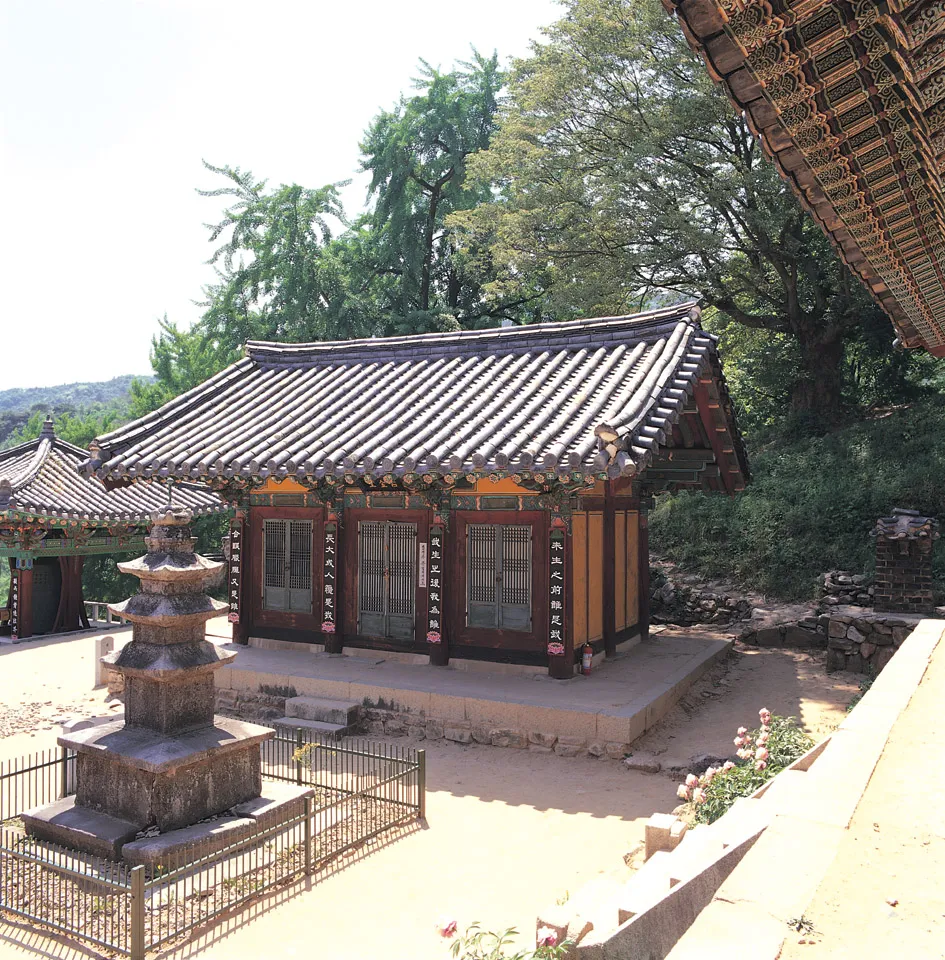
Gogeumdang Hall of Bongjeongsa Temple, Andong
安東 鳳停寺 古金堂
경상북도 안동시
Basic information
- Designation
- Treasure No.449
- Category
- Architecture
- Era
- 조선시대 중기
- Designated year
- 1967
- Location
- 안동시, 경상북도— 경북 안동시 서후면 봉정사길 222 (태장리)
- Coordinates
- 36.653384, 128.662300
AI Docent
✨ AI-generated# Gogeumdang Hall of Bongjeongsa Temple, Andong Welcome to Gogeumdang Hall, a hidden gem of Korean temple architecture tucked away in Andong. This modest building—part of Bongjeongsa Temple, which dates back to the late 7th century—tells a fascinating story through its walls. Though small, Gogeumdang Hall is architectural proof that size doesn't determine significance. Built around 1616, it blends multiple construction styles with impressive craftsmanship. Notice the distinctive gable roof shaped like the character 人, and the bracket system supporting the eaves—details that reveal masterful design. Originally meant to house a Buddhist statue, the hall now serves as a monk's residence. Its journey matters too: a 1969 restoration revealed secrets about its past, reminding us that these buildings continue speaking across centuries. You're standing in a structure that historians treasure for understanding Korean building techniques. Gogeumdang Hall exemplifies why Bongjeongsa Temple earned UNESCO recognition as one of Korea's sacred mountain temples.
⚠ This is an AI-generated retelling of the official description. For accuracy, refer to the official description below.
Description
According to a sangnyangmun (message concerning a ridge beam raising ceremony) of Geungnakjeon Hall, Bongjeongsa Temple appears to have been built by Great Monk Neungin in the late 7th century while legend has it that the temple was built in 672. Gogeumdang Hall stands facing east in front of Geungnakjeon Hall. It is assumed that Gogeumdang Hall was originally intended as an annex to enshrine a Buddhist statue, but it is now inhabited by a monk. According to the record found during restoration work carried out in 1969, the building was repaired in 1616 (the 8th year of the reign of Prince Gwanghae of the Joseon Dynasty); however, the exact construction year is unknown. Gogeumdang Hall measures three kan (a unit of measurement referring to the distance between two columns) at the front and two kan at the sides, and has a gable roof resembling the character 人 when viewed from the side. Before the restoration work, the building had a different style of roof (in the northern part), a narrow wooden veranda in front of the room, and a door for each kan. However, a pair of hinged doors is now installed at the front, and the building is walled at the sides and back. The eaves of the roof are supported by a system of brackets placed on the pillars. Although the hall is small, it was built by combining various construction styles and is well structured. Gogeumdang Hall of Bongjeongsa Temple is regarded as an important cultural asset for the study of Korea’s architectural history. *Bongjeongsa Temple is known to have been built by Buddhist Master Uisang in 682 (the second year of the reign of King Sinmun of the Silla Dynasty). According to a legend, Master Uisang, the founder of Buseoksa Temple, made a phoenix from paper and released it into the sky, and built a temple, which he named Bongjeongsa, at the place where the paper phoenix landed.
Location
지도를 불러오는 중…
Have you visited this place?
Log in and verify your visit on-site via GPS to record a stamp in My Journey. (QR verification coming later.)
Images: KOGL (khs.go.kr) · Data source: Korea Heritage Service Open API (khs.go.kr)