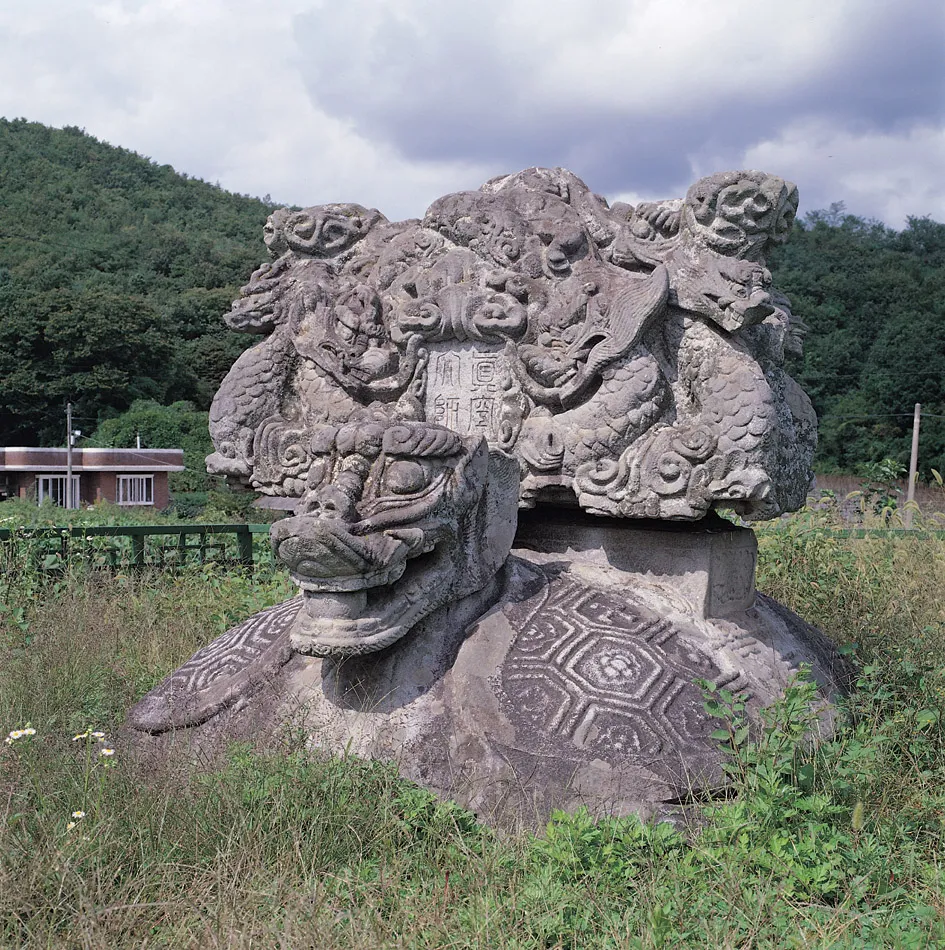
Stele of Buddhist Monk Jingong at Heungbeopsa Temple Site, Wonju
原州 興法寺址 眞空大師塔碑
강원특별자치도 원주시
Basic information
- Designation
- Treasure No.463
- Category
- Sculpture
- Era
- 고려시대
- Designated year
- 1968
- Location
- 원주시, 강원특별자치도— 강원 원주시 지정면 안창리 517-2번지
- Coordinates
- 37.338466, 127.814879
AI Docent
Coming soonAn AI-generated, friendly retelling of this heritage site is available in Korean. An English version is on our roadmap — for now, please see the official description below.
Description
Remaining on the former site of Heungbeopsa Temple, this stele is dedicated to Jingong (869-940), the great Buddhist monk from the late Unified Silla Period to the early Goryeo Dynasty. The main body with inscription was broken down, and its fragments were moved to National museum of Korea. Only the pedestal and the capstone remain here. Monk Jingong became a monk under Master Jangsun. After he came back from his study in the Tang Dynasty of China, he was appointed preceptor to King Gongyang. Moved by his preaching, the first king of Goryeo Dynasty, Taejo, asked him to be preceptor to the king, but he declined the offer and spent his life in Sobaeksan Mountain. When he died in 940 (the 23rd year of the reign of King Taejo), the stele was erected with its inscription composed by King Taejo and written by Choe Gwang-yun by collecting the calligraphies of Emperor Taizong of the Tang Dynasty. The tortoise-shaped pedestal seems to have the head of a dragon holding a magic jewel in its mouth and standing with its four feet on the ground. It has a short neck and bears octagonal patterns on its back on which 卍 (meaning “fullness”) and lotus flowers are carved. The front middle of the capstone carries the title of the stele, around which are carvings of wobbling dragons in the clouds. Two of the dragons are glaring at each other, and the remaining two on both corners are merely watching on the sidelines. Its backside, also carved with four dragons each of which are looking at different directions, also shows the high level of art at that time through its carvings with majestic power as well as the delicate description. The inscription of the main body of the stele preserved in National museum of Korea is hard to read because it was broken into pieces, but it seems to have a record of the life and achievements of monk Jingong.
Location
지도를 불러오는 중…
Have you visited this place?
Log in and verify your visit on-site via GPS to record a stamp in My Journey. (QR verification coming later.)
Images: KOGL (khs.go.kr) · Data source: Korea Heritage Service Open API (khs.go.kr)