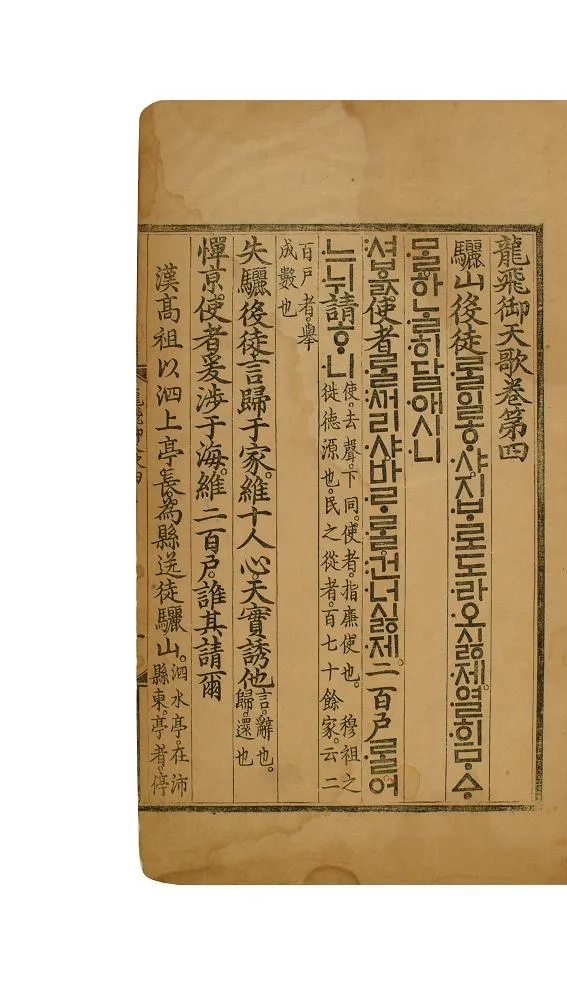
Yongbieocheonga Gwon3, 4
龍飛御天歌 卷三, 四
서울특별시 종로구
Basic information
- Designation
- Treasure No.1463-2
- Category
- Books & Records
- Era
- 1447년경
- Designated year
- 2009
- Location
- 종로구, 서울특별시— 서울 종로구 새문안로 55, 서울역사박물관 (신문로2가,서울역사박물관)
- Coordinates
- 37.570149, 126.970429
AI Docent
Coming soonAn AI-generated, friendly retelling of this heritage site is available in Korean. An English version is on our roadmap — for now, please see the official description below.
Description
Yongbieocheonga (Songs of Dragons Flying in Heaven) is a musical text accompanied by the annotations of songs that were composed by rhyming couplets between the historical achievements of six Joseon kings (i.e. from King Mokjo to King Taejong) and those of successive generations of Chinese kings. Yongbieocheonga consists of 125 cantos with Korean lyrics and the corresponding Chinese poems, and each chapter includes its annotation. The songs, which proclaim that the Joseon Dynasty was founded according to a Mandate from Heaven, lay the ideological foundations for future generations of Joseon rulers to follow. The purpose and the progress of the composition of the songs are clearly explained in the preface written by Jeong In-ji in 1445 (the 27th year of the reign of King Sejong), the preamble written by Gwon Je, and the epilogue written by Choi Hang in 1447. According to these records, the texts were composed by Gwon Je, Jeong In-ji, An Ji and others in 1445, while the annotations were written by Choe Hang, Bak Paeng-nyeon, and Gang Hui-an among others at the behest of King Sejong, so that the songs were published in 1447. This book corresponds to volumes 3 and 4 of the first edition of Yongbieocheonga. Although parts of the contents are missing from both the beginning of volume 3 and the end of volume 4, overall the book is in good condition and the printing is excellent. Three copies of the middle edition, which was published following the system of the first edition after the publication thereof, have survived to the present day. As the first work written in Korean after the creation of Hangeul, the Korean lyrics of the 125 cantos of Yongbieocheonga are the oldest printed example of the Korean language. In addition, the Korean inscriptions of proper nouns and the names of official positions are invaluable materials for studies on the history of Korean language.
Location
지도를 불러오는 중…
Have you visited this place?
Log in and verify your visit on-site via GPS to record a stamp in My Journey. (QR verification coming later.)
Images: KOGL (khs.go.kr) · Data source: Korea Heritage Service Open API (khs.go.kr)