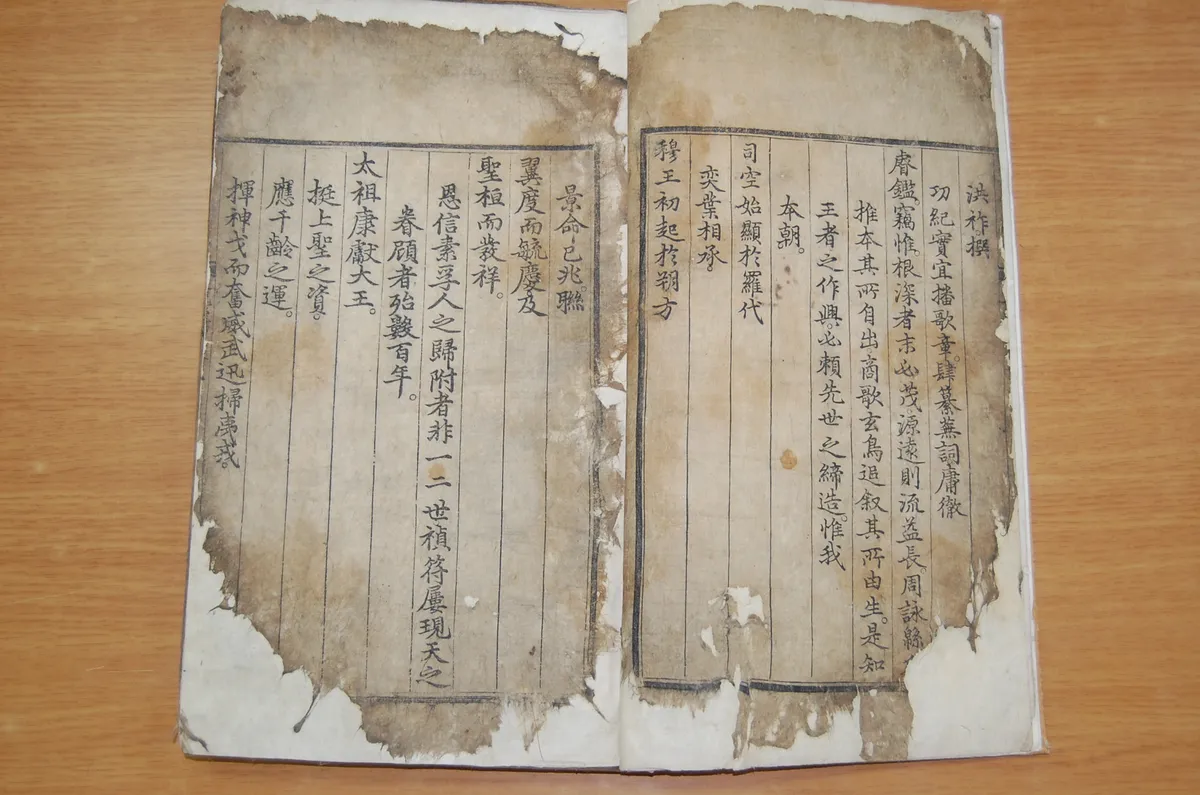
Yongbieocheonga Gwon1~2
龍飛御天歌 卷一~二
서울특별시 관악구
Basic information
- Designation
- Treasure No.1463-3
- Category
- Books & Records
- Era
- 1447년(세종29년)
- Designated year
- 2009
- Location
- 관악구, 서울특별시— 서울 관악구 관악로 1,103호 동 서울대학교 규장각한국학연구원 (신림동,서울대학교)
- Coordinates
- 37.462351, 126.950453
AI Docent
Coming soonAn AI-generated, friendly retelling of this heritage site is available in Korean. An English version is on our roadmap — for now, please see the official description below.
Description
Yongbieocheonga (Songs of Dragons Flying in Heaven) was written in the form of cantos that proclaim the foundation of the Joseon Dynasty and the historic achievements of the six ancestors of the Joseon Dynasty from King Mokjo (King Taejo’s great-great-grandfather) to King Taejong and those of successive generations of Chinese kings. The songs were published in order to announce the justification for the foundation of the Joseon Dynasty by the Mandate from Heaven. Yongbieocheonga consists of 125 cantos with Korean lyrics and the corresponding Chinese poems, and each chapter includes its annotation. The texts were composed by Gwon Je, Jeong In-ji, An Ji and others in 1445 (the 27th year of the reign of King Sejong), while the annotations and the pronunciation and the meanings (of the Chinese characters) were written by Choe Hang, Bak Paeng-nyeon, Gang Hui-an and others, so that the songs were published in five books consisting of ten volumes in 1447. According to a record in Sejong Sillok (Annals of King Sejong), 550 copies of Yongbieocheonga were distributed to civil servants in October, 1447. As Yongbieocheonga is the first document ever to have been written in Hunminjeongeum (Hangeul, the Korean alphabet), it is an extremely valuable resource, particularly for studies of the Korean language. The version of Yongbieocheonga kept at Seoul National University’s Kyujanggak Institute for Korean Studies is the original edition published in 1447, of which only one book out of the original volumes 1 and 2 remains today. Its print is in good condition, and the word Seonsajigi is stamped on the first volume. Several parts are missing from volumes 1 and 2, including the front page of chapter 3 Jinjeonmun, which is the beginning part of the book; the rear page of chapter 1 of volume 1; chapters 44 to 46 of the end part of volume 2; and some parts of chapters 41 and 42 of volume 2. The cover of the book was reproduced and the title is written in Chinese ‘龍飛御天歌第一·二 (Yongbieocheonga Volumes 1 and 2)’ on a separate paper attached to the cover. The version of Yongbieocheonga kept at Kyujanggak Institute is also valuable for the study of Korean language and bibliography during the reign of King Sejong of the Joseon Dynasty. The 125 cantos with Korean lyrics and Chinese poems are regarded as both an important literary work and as a valuable resource for studies of the Korean language at the time of the creation of Hunminjeongeum; while the archaic versions of proper nouns and the names of official positions contained in the annotations are regarded as an important material for research on the Korean language. Although some parts of the book are missing, it is a rare but well-preserved version of Yongbieocheonga.
Location
지도를 불러오는 중…
Have you visited this place?
Log in and verify your visit on-site via GPS to record a stamp in My Journey. (QR verification coming later.)
Images: KOGL (khs.go.kr) · Data source: Korea Heritage Service Open API (khs.go.kr)