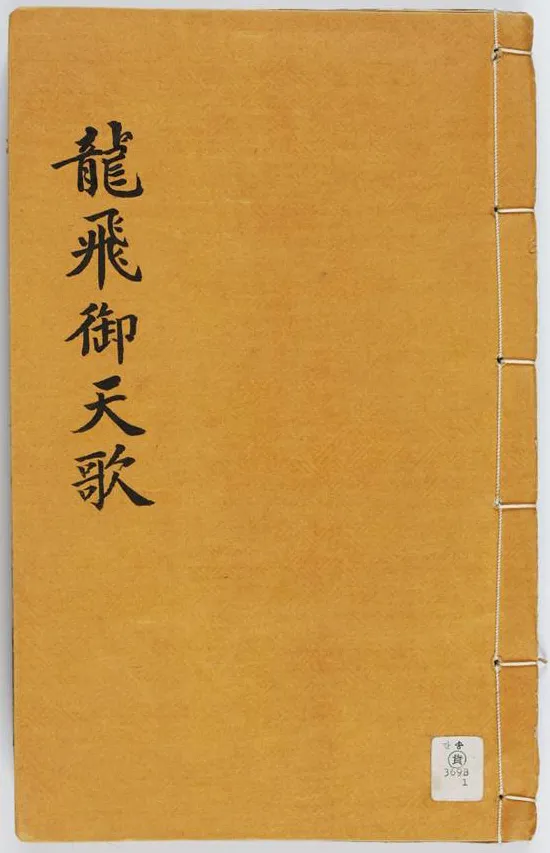
Yongbieocheonga Gwon1~2, 7~8
龍飛御天歌 卷一~二, 七~八
서울특별시 성북구
Basic information
- Designation
- Treasure No.1463-4
- Category
- Books & Records
- Era
- 1447년(세종29년)
- Designated year
- 2009
- Location
- 성북구, 서울특별시— 서울 성북구 안암로 145, 중앙도서관 (안암동5가,고려대학교안암캠퍼스(인문사회계))
- Coordinates
- 37.589200, 127.032686
AI Docent
Coming soonAn AI-generated, friendly retelling of this heritage site is available in Korean. An English version is on our roadmap — for now, please see the official description below.
Description
These two books are possessed by Mansong’s collection of books of Korea University Library as for the book of volumes 1 and 2 of Yongbieocheonga and for the book of volumes 7 and 8 of Yongbieocheonga. Published in 1447, they are the same editions as Yongbieocheonga possessed by Seoul National University’s Kyujanggak Institute for Korean Studies as , Treasure No. 1463-2 (Volumes 3 and 4 owned by the History Museum), and Treasure No. 1463-1 (Volumes 8 and 10 owned by Keimyung University). Chapters 1-3 of the preface in volume 1 and parts of chapters 44-46 in volume 2 are missing, while chapter 45 of volume 2 contains only three lines, and lacks the fourth to ninth lines. The title of volumes 7 and 8 is written in Chinese, i.e. 龍飛御天歌 (Yongbieocheonga), on a separate sheet of paper attached to the cover, which is slightly worn but otherwise in good condition. Notably, volume 7 is the only version, and volume 8 is in better condition than the version kept by Keimyung University. As the quality of the paper and the printing is good and the texts of the book are generally well preserved, it is sufficiently valuable to have been designated as a treasure by the state. Yongbieocheonga was the first work to be written in Korean after the creation of Hangeul. The Korean lyrics of the 125 cantos are the oldest example of use of the Korean alphabet, and the Korean inscriptions of proper nouns and the names of official positions in the annotations are regarded as an important material for study of the Korean language. As these two books consisting of volumes 1 and 2 and volumes 7 and 8 of Yongbieocheonga (all owned by Mansong’s collection of books of Korea University Library) are rare, well-preserved first editions published in 1447 (the 29th year of the reign of King Sejong), they are regarded as valuable cultural treasures.
Location
지도를 불러오는 중…
Have you visited this place?
Log in and verify your visit on-site via GPS to record a stamp in My Journey. (QR verification coming later.)
Images: KOGL (khs.go.kr) · Data source: Korea Heritage Service Open API (khs.go.kr)