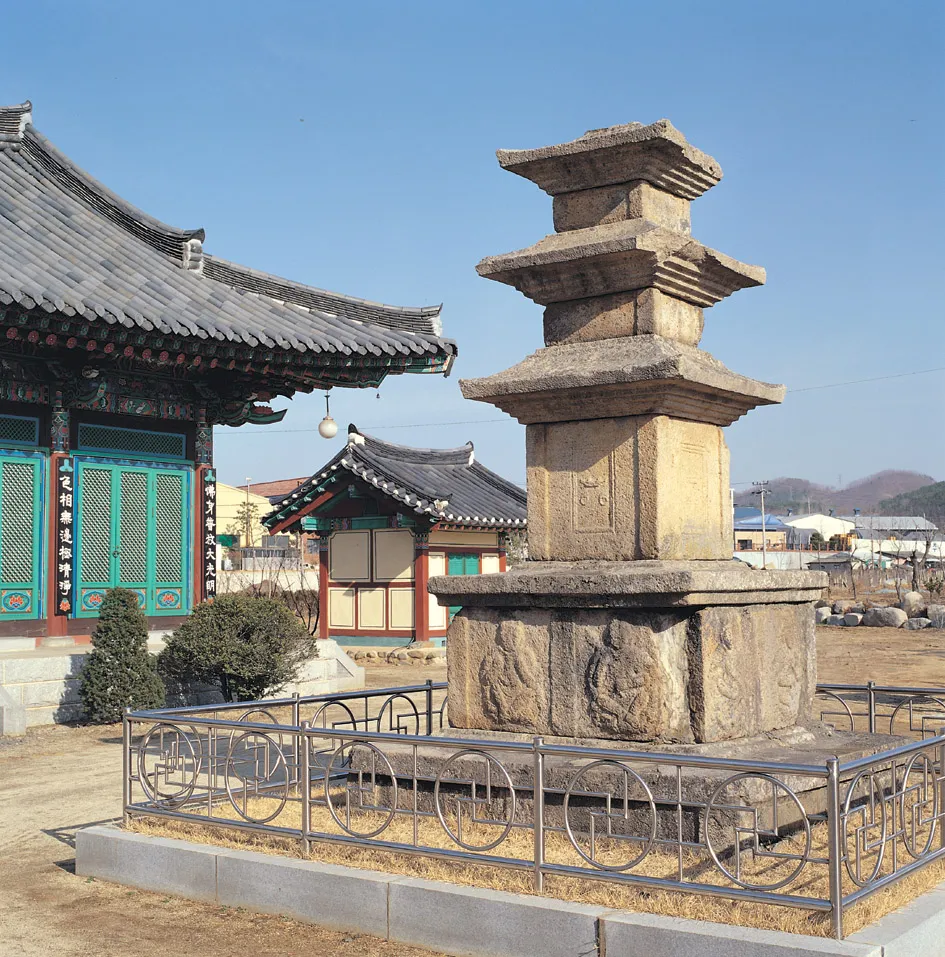
Three-story Stone Pagoda in Sinwol-ri, Yeongcheon
永川 新月里 三層石塔
경상북도 영천시
Basic information
- Designation
- Treasure No.465
- Category
- Sites & Pagodas
- Era
- 통일신라시대
- Designated year
- 1968
- Location
- 영천시, 경상북도— 경북 영천시 금호읍 금호로 360-29, 신흥사 (신월리)
- Coordinates
- 35.937501, 128.898758
AI Docent
Coming soonAn AI-generated, friendly retelling of this heritage site is available in Korean. An English version is on our roadmap — for now, please see the official description below.
Description
This 4.75m-high three-story stone pagoda was erected during the 9th century of the Unified Silla Period. The name and size of the temple where this pagoda was originally built are unknown. Note, however, that the new Buddhist sanctuary, called Sinheungsa Temple, was recently built on this site where the pagoda is preserved. As with all typical three-story pagodas built during the Unified Silla Period, this pagoda consists of two-layer stylobate and three-story main body that looks like a tile-roofed house. Each of the corners and the middle of every facet of the two-layer stylobate are carved with a pillar pattern. Every facet of the upper layer of the stylobate is engraved with one of eight images of Palbujungsang, i.e., eight guardian deities of Buddhist law who frequently appeared on the stylobates of the stone pagodas of the Unified Silla Period to protect the Buddha’s sarira or Buddhist scriptures. Each of the core stone and roof stone of the main body is hewn from a single stone. All the corners of the core stones are engraved with pillar patterns. All the four facets of the core stone for the first story are carved with a design of a door whose lock and door handle are expressed. The roof stones have four-tier cornices. The eaves are horizontal but seem thick. The four edges of the roof stones curve swiftly upward. On the whole, the pagoda is not well-balanced since the core stone of the first story is too large compared to others, and all carvings on every facet seem a bit exaggerated. Nonetheless, it retains the beauty of the construction style of the pagoda of the time.
Location
지도를 불러오는 중…
Have you visited this place?
Log in and verify your visit on-site via GPS to record a stamp in My Journey. (QR verification coming later.)
Images: KOGL (khs.go.kr) · Data source: Korea Heritage Service Open API (khs.go.kr)