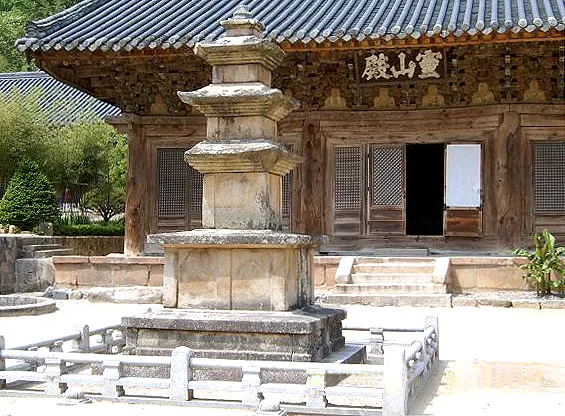
Tongdosa Three-story Stone Pagoda, Yangsan
梁山 通度寺 三層石塔
경상남도 양산시
Basic information
- Designation
- Treasure No.1471
- Category
- Sites & Pagodas
- Era
- 통일신라시대(9세기 말)
- Designated year
- 2006
- Location
- 양산시, 경상남도— 경남 양산시 하북면 통도사로 108 (지산리)
- Coordinates
- 35.487868, 129.064932
AI Docent
Coming soonAn AI-generated, friendly retelling of this heritage site is available in Korean. An English version is on our roadmap — for now, please see the official description below.
Description
The three-story stone pagoda of Tongdosa Temple is a typical Unified Silla pagoda in terms of its overall form. It stands 3.9m tall and has a 1.8m-wide two-tier stylobate that sits on top of a layer of large foundation stones. Each story of the pagoda’s body consists of one core stone and one roof stone. Its stylistic characteristics are as follows: 1) Each face of the lower tier of the stylobate is carved with the symbolic images of the elephant’s eyes without pillar patterns. Similar examples from the Silla Dynasty include the three-story stone pagodas at Beomeosa Temple in Busan; Pyeonghwa-dong, Andong; the Mujangsa Temple Site in Gyeongju; Giseong-ri, Chilgok; and Suljeong-ri, Changnyeong. 2) The roof stones have slightly-lifted corners and ridges on the roof face. Generally, Silla stone pagodas feature roof stones with smooth straight faces and corners that turn lightly upward. Major examples include the East and West Three-story Stone Pagodas of Silsangsa Temple, Namwon (Treasure No. 37), and the Three-story Stone Pagoda of Daeheungsa Temple, Haenam (Treasure No. 320). Given that these structures were built in the latter half of the 9th century, it can be safely assumed that the Three-story Stone Pagoda of Tongdosa Temple was erected around the same time. Gutters at the bottom of the roof stone were introduced in the 8th century and quickly became a common element of Silla stone pagodas. This pagoda is an important relic that is evidently a stone version of the earlier wooden pagodas.
Location
지도를 불러오는 중…
Have you visited this place?
Log in and verify your visit on-site via GPS to record a stamp in My Journey. (QR verification coming later.)
Images: KOGL (khs.go.kr) · Data source: Korea Heritage Service Open API (khs.go.kr)