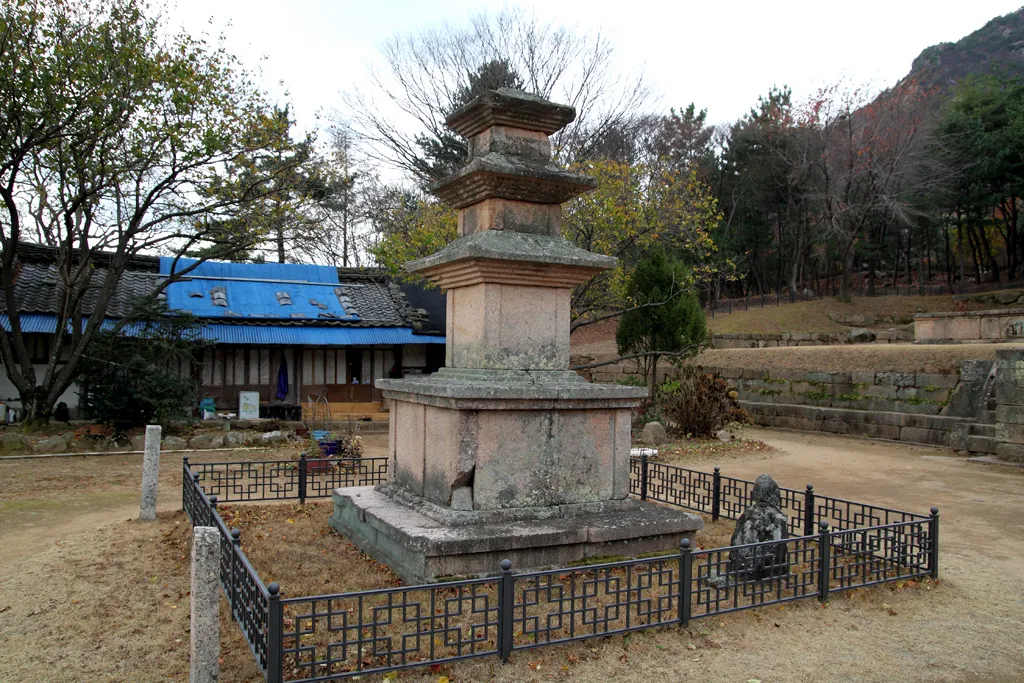
Three-story Stone Pagoda at Yeongamsa Temple Site, Hapcheon
陜川 靈岩寺址 三層石塔
경상남도 합천군
Basic information
- Designation
- Treasure No.480
- Category
- Sites & Pagodas
- Era
- 신라시대 후기
- Designated year
- 1968
- Location
- 합천군, 경상남도— 경상남도 합천군 가회면 둔내리 1659
- Coordinates
- 35.474297, 128.002876
AI Docent
Coming soonAn AI-generated, friendly retelling of this heritage site is available in Korean. An English version is on our roadmap — for now, please see the official description below.
Description
Machine-translatedThis English description was machine-translated and may contain inaccuracies. Refer to the original Korean text for details.
The Samgyeong Stone Pagoda of Yeongamsa in Hapcheon is a three-story stone pagoda characteristic of Unified Silla style, constructed on a two-tier base platform. Located at the southern foot of Mount Hwangmaesa, Yeongamsa was a temple site dating from the Silla period, though its founding year remains unknown. Historical records indicate that Jekyeon Seonsa was ordained here in 1014, suggesting the temple was established before that date. The stone pagoda had its upper portion collapsed, which was restored in 1969, and it now stands between two newly constructed buildings in front of the main hall. The base platform features pilaster-like carvings at the corners and center. The pagoda body consists of single-stone body blocks and roof stones, with pillars carved on the body edges. The first-story body stone is relatively taller, while the second and third stories are considerably reduced. The underside of the roof stones features four-tiered supports, with horizontal eaves and gentle curving roof lines that slightly uplift at the four corners. The finial of the pagoda is completely missing, though a hole for inserting an iron rod is visible on the upper surface of the third-story roof stone. Despite the slightly elevated appearance of the upper platform and first-story body, the overall proportions remain balanced with clean and concise structural joinery. While following the style of Silla stone pagodas, the weakened pilaster expression and reduced number of roof stone supports suggest construction dating to the ninth century.
Location
지도를 불러오는 중…
Have you visited this place?
Log in and verify your visit on-site via GPS to record a stamp in My Journey. (QR verification coming later.)
Images: KOGL (khs.go.kr) · Data source: Korea Heritage Service Open API (khs.go.kr)