Documents of Yun Seon-do's Family
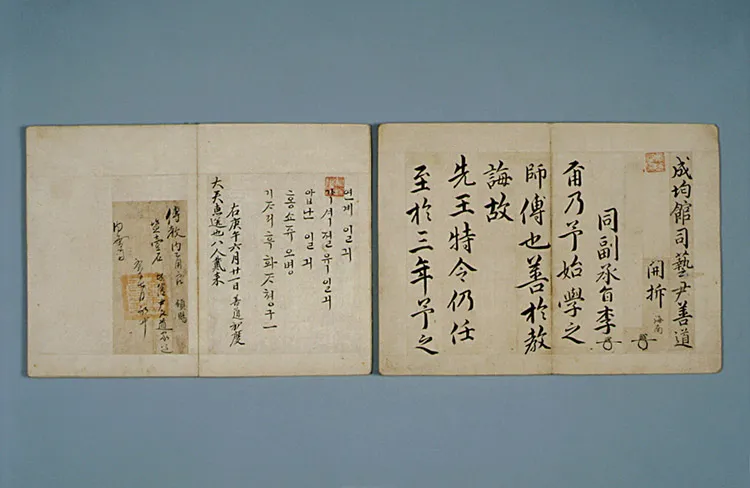
尹善道 宗家 文籍
전라남도 해남군
Basic information
- Designation
- Treasure No.482
- Category
- Books & Records
- Era
- 조선 선조∼현종 연간
- Designated year
- 1968
- Location
- 해남군, 전라남도— 전남 해남군 해남읍 녹우당길 130 (연동리)
- Coordinates
- 34.549730, 126.620817Kakao address conversion
AI Docent
Coming soonAn AI-generated, friendly retelling of this heritage site is available in Korean. An English version is on our roadmap — for now, please see the official description below.
Description
This is an album of paintings by Yun Du-seo (1668-1715) called Seohwacheop. Yun was a scholar-artist, who together with Jeong Seon and Sim Sa-jeong, was one of the three leading painters of the later period of the Joseon Dynasty. With his keen curiosity and excellent brush technique, he was famous for his drawings and paintings of horses and for his portraits. Seohwacheop contains three volumes, 'Self-portrait' and 'Songhacheosado', two painting albums of 'Treasures of theYun Family' and three volumes of 'Gajeonyumuk'. The first volume consists of 'Seonmyeon' (drawings on fans made of fabric or paper), drawn between 1704 and 1708, the 30th to 34th years of the reign of King Sukjong of the Joseon Dynasty. The other volume has drawings and paintings of different sizes and with different subjects such as landscapes, portraits, and genre subjects. The best known are 'Baengmado' (painting of a white horse), 'Seonchado' (carpentering) and 'Chaeaedo' (a woman collecting wild herbs). 'Baengmado' in particular captures the liveliness of a big, solidly built horse slightly raising a rear leg. It is assumed that Yun Du-seo's genre paintings influenced those of Kim Hong-do, and this collection is an important source revealing the scholar-artist’s artistic world and his talents. It is especially valuable for allowing us an insight into the realistic approach he took to his work.
Location
지도를 불러오는 중…
Have you visited this place?
Log in and verify your visit on-site via GPS to record a stamp in My Journey. (QR verification coming later.)
Images: KOGL (khs.go.kr) · Data source: Korea Heritage Service Open API (khs.go.kr)