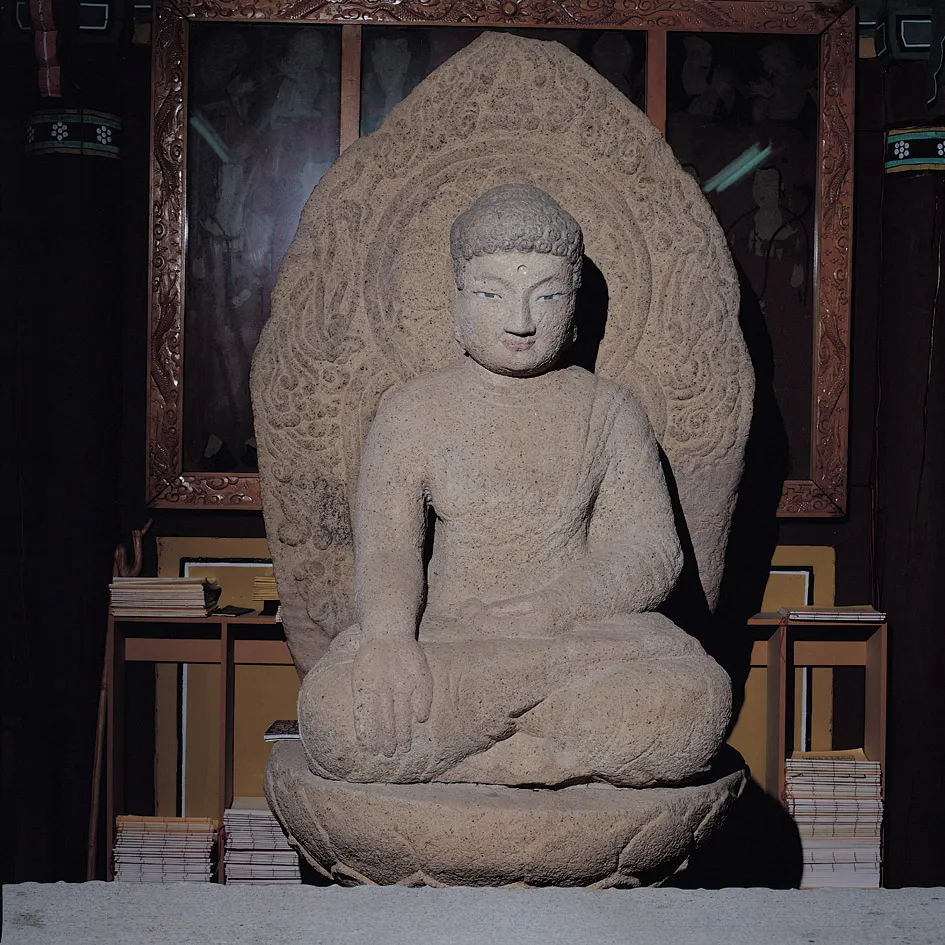
Stone Seated Buddha of Yonghwasa Temple, Yangsan
梁山 龍華寺 石造如來坐像
경상남도 양산시
Basic information
- Designation
- Treasure No.491
- Category
- Sculpture
- Era
- 통일신라시대
- Designated year
- 1968
- Location
- 양산시, 경상남도— 경남 양산시 물금읍 원동로 199-133, 용화사 (물금리)
- Coordinates
- 35.316246, 128.974929
AI Docent
Coming soonAn AI-generated, friendly retelling of this heritage site is available in Korean. An English version is on our roadmap — for now, please see the official description below.
Description
This stone seated Buddha, which remains as a complete form including its pedestal and mandorla (Buddhist halo of light), was originally located in a temple in Gamno-ri, Sangdong-myeon, Gimhae County. It was moved to a nearby riverside around the end of the Joseon Dynasty, and was then transferred to its present location in February 1947 when the Buddhist sanctuary was rebuilt at Yonghwasa Temple. The robust shoulders, broad chest, arms and legs are expressed with a sense of volume and exhibit a three-dimensional sense, but the hands, neck and other details are presented in a more formal fashion. The square face looks powerful with its protruding forehead, but the narrowly-open eyes, small nose and mouth are all typical features of the late Unified Silla era statue style. The robe covering the left shoulder but leaving the right shoulder exposed is tight on the body with simple folds. The mandorla, which depicts the light emanating from the Buddha’s body, is engraved with patterns of sparks, lotus flowers and clouds. The top of the mandorla is carved with a small Buddha and a figure of a flying maid, a very rare example of an image which can also be found on the mandorla of the Rock-carved Seated Buddha at Bungmireugam Hermitage of Daeheungsa Temple, Haenam (National Treasure No. 308). The octagonal pedestal on which the statue is sitting is engraved with lotus flower patterns and flying Bodhisattva images. This stone seated Buddha shows characteristics of statues from the mid-Unified Silla period, but as its details of are expressed in a more formal way than in the statues of that time, it is assumed that it was made during late Unified Silla.
Location
지도를 불러오는 중…
Have you visited this place?
Log in and verify your visit on-site via GPS to record a stamp in My Journey. (QR verification coming later.)
Images: KOGL (khs.go.kr) · Data source: Korea Heritage Service Open API (khs.go.kr)