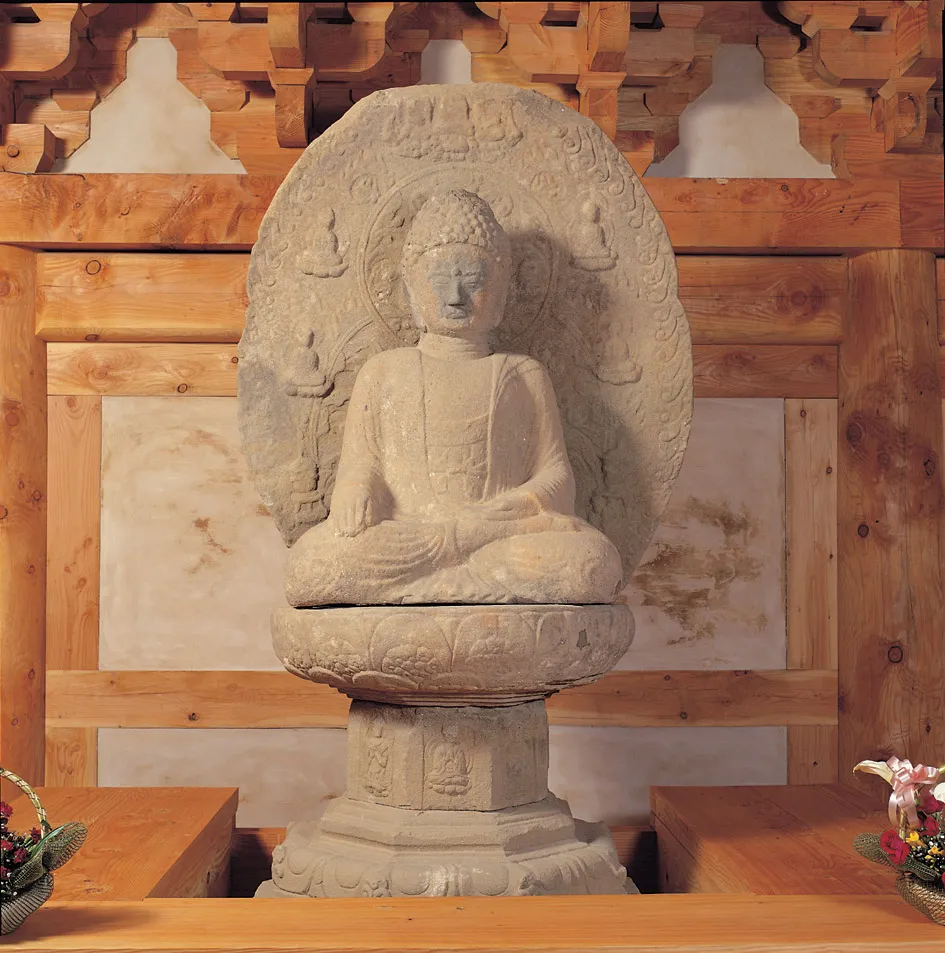
Stone Seated Buddha in Haepyeong-ri, Gumi
龜尾 海平里 石造如來坐像
경상북도 구미시
Basic information
- Designation
- Treasure No.492
- Category
- Sculpture
- Era
- 통일신라시대
- Designated year
- 1968
- Location
- 구미시, 경상북도— 경상북도 구미시 해평4길 86(해평면, 보천사)
- Coordinates
- 36.203786, 128.373984
AI Docent
Coming soonAn AI-generated, friendly retelling of this heritage site is available in Korean. An English version is on our roadmap — for now, please see the official description below.
Description
This is the principal Buddha statue at Bocheonsa Temple. Although the face and body are a little damaged, the mandorla (Buddhist halo of light) and the pedestal of the statue are preserved well. The Buddha’s hair is expressed in the curly nabal style (i.e. twirled up and around in a seashell-shaped fashion), and an usnisa (a protuberance symbolizing supreme wisdom) can just be seen on top of his head. The clothing hanging from both shoulders seems stiff and sagging, but the knotted band on the stomach is unique. While the left hand is placed on the stomach area, the right hand rests on top of the knee with the fingers spread downwards in a gesture representing the expulsion of evil (Bhumisparsa mudra). The most important part of this statue is the mandorla, which depicts the light emanating from the body, and the pedestal on which the Buddha is sitting. The dugwang (light radiating from the head) and singwang (light emanating from the body) are both depicted in double circles decorated inside with designs of vines, and the middle of the dugwang is engraved with lotus flower patterns. The mandorla is engraved in places with several small figures of Buddha, and its lower area is carved with a design of an incense burner. In addition, magnificent spark patterns are carved along the edges of the whole mandorla. The pedestal is divided into three parts, upper, middle, and lower. The upper part takes the shape of a semicircle and is engraved with full-blown lotus flowers. The middle and lower parts are octagonal and are carved with patterns of lotus flowers, clouds, and flying maids. Judging from the sophisticated and splendid styles of the mandorla and pedestal, and the neat expression of the face and body, this is considered typical of the style of Buddha statues made during the ninth century.
Location
지도를 불러오는 중…
Have you visited this place?
Log in and verify your visit on-site via GPS to record a stamp in My Journey. (QR verification coming later.)
Images: KOGL (khs.go.kr) · Data source: Korea Heritage Service Open API (khs.go.kr)