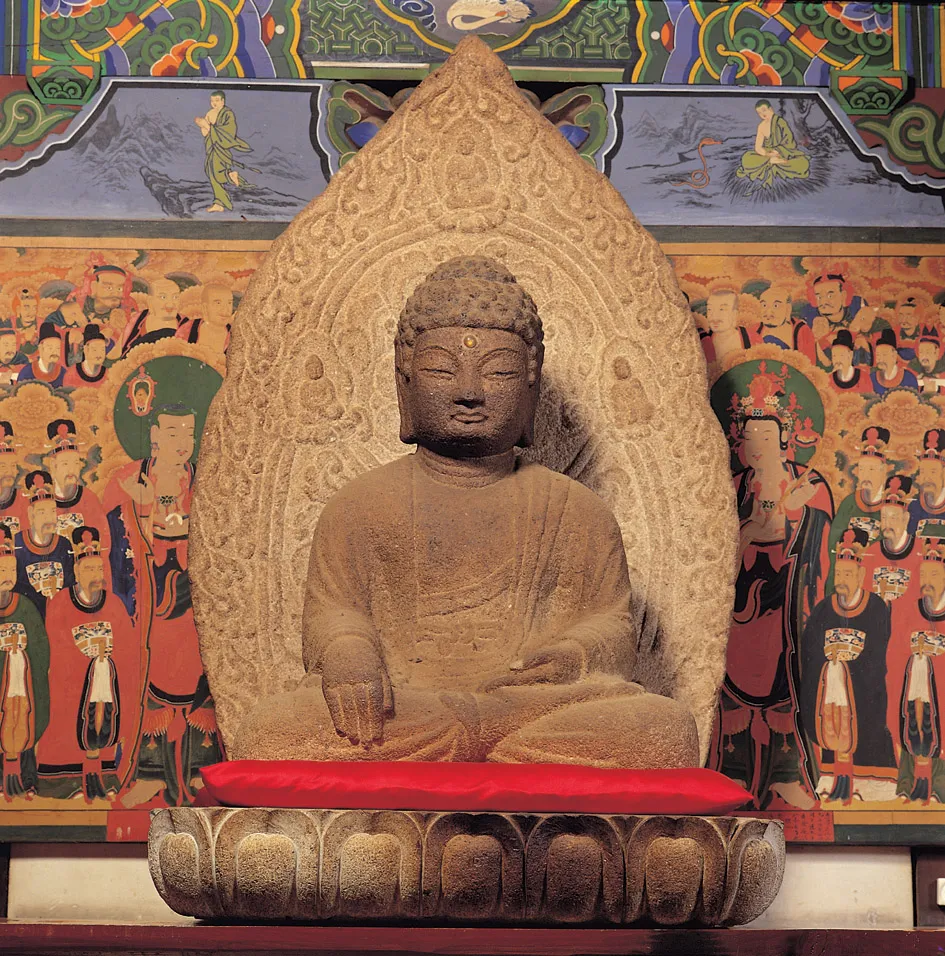
Stone Seated Buddha of Mubongsa Temple, Miryang
密陽 舞鳳寺 石造如來坐像
경상남도 밀양시
Basic information
- Designation
- Treasure No.493
- Category
- Sculpture
- Era
- 통일신라시대
- Designated year
- 1969
- Location
- 밀양시, 경상남도— 경남 밀양시 영남루1길 16-11, 무봉사 (내일동)
- Coordinates
- 35.491718, 128.756653
AI Docent
Coming soonAn AI-generated, friendly retelling of this heritage site is available in Korean. An English version is on our roadmap — for now, please see the official description below.
Description
This stone seated Buddha, 0.97m in height, is enshrined in the Daeungjeon Hall (the main sanctuary) of Mubongsa Temple, which is said to have been founded as an annex to Yeongnamsa Temple by the Monk Beopjo in 733, the ninth year of the reign of King Hyegong of the Silla Dynasty. Although the statue has plain images of a square face, thin eyes and lips, a wide nose, and a short neck, it exudes a neat appearance. Broad, round shoulders make the chest look shrunken in comparison. The Buddha’s beobui (sacerdotal robe), draped over both shoulders, is so thick that folds in the clothes and the shape of the body are not apparent. The mandorla (Buddhist halo of light) is made up of dugwang (light radiating from the head) behind the head and singwang (light emanating from the body), with a thick double line dividing them in two. The area inside the double line features patterns of vine and lotus flower, while outside, spark patterns are expressed in a sophisticated way. The front side of the mandorla is engraved with five small Buddha images, while the back side has an image of Bhaisajyaguru Buddha sitting on a lotus-patterned pedestal, something rarely found among examples of mandorla, but is the same style as the Stone Seated Buddha in Mireukgok Valley of Namsan Mountain, Gyeongju (Treasure No. 136). Judging from the body expression with its sense of neatness and volume, the simplified folds of the robe, and the splendid and complex expression of the mandorla, it is concluded that the statue was made during the late Unified Silla Period.
Location
지도를 불러오는 중…
Have you visited this place?
Log in and verify your visit on-site via GPS to record a stamp in My Journey. (QR verification coming later.)
Images: KOGL (khs.go.kr) · Data source: Korea Heritage Service Open API (khs.go.kr)