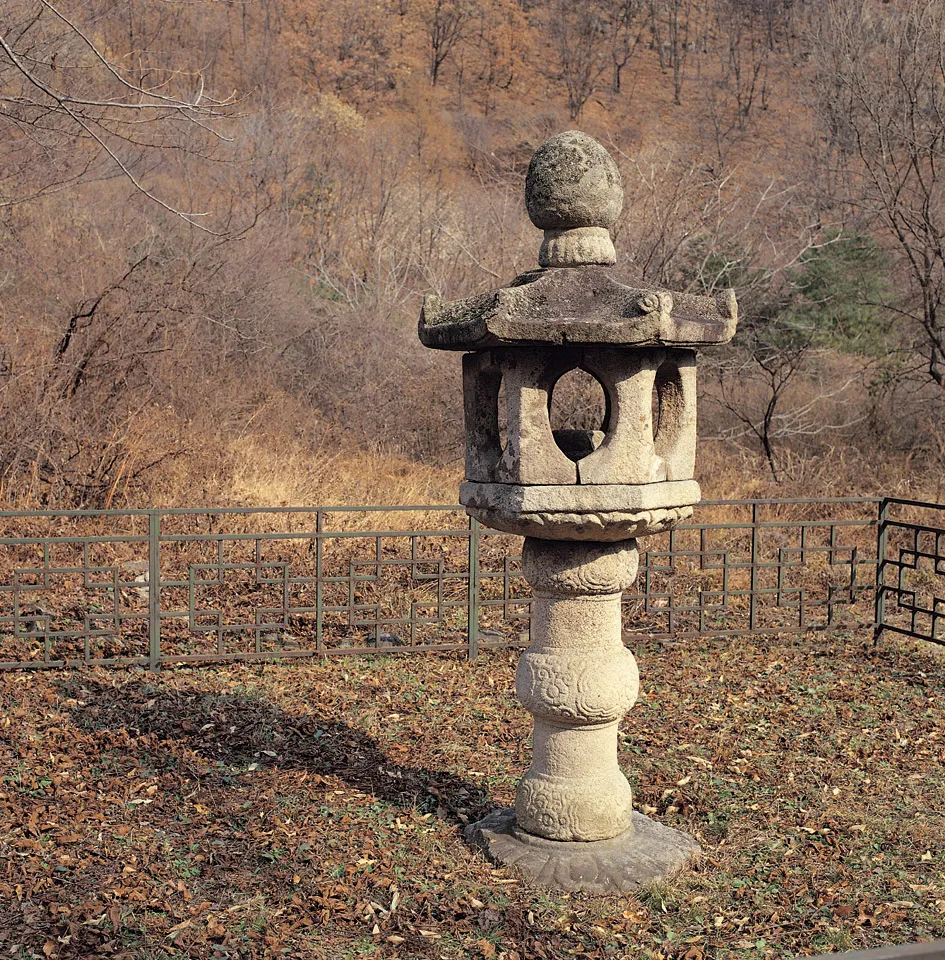
Stone Lantern in Gyeseong-ri, Hwacheon
華川 啓星里 石燈
강원특별자치도 화천군
Basic information
- Designation
- Treasure No.496
- Category
- Sites & Pagodas
- Era
- 고려시대 초기
- Designated year
- 1968
- Location
- 화천군, 강원특별자치도— 강원 화천군 하남면 계성리 594번지
- Coordinates
- 38.096412, 127.589846Kakao address conversion
AI Docent
Coming soonAn AI-generated, friendly retelling of this heritage site is available in Korean. An English version is on our roadmap — for now, please see the official description below.
Description
This stone lantern dating from the Goryeo Dynasty is located in Gyeseong-ri village. This was once the site of Gyeseongsa Temple, and parts of a stone pagoda and a bell-shaped stupa are scattered around the village. The lantern was forcibly moved 200m below the temple during the time of Japanese imperialism (1910-1945), and its original location is not known. A stone lantern generally consists of the light chamber in the middle, the three-layered base stone at the bottom, and a roof stone and ornamental finial at the top. This particular lantern is hexagonal in shape, different from the usual quadrangular style made during the Goryeo Dynasty and the octagonal style of the Silla Dynasty. The lower base stone is mostly buried underground so its top part is barely visible. The middle base stone has the shape of a column belted with protruding adorned bands. This column style of the middle base stone is common in Goryeo lanterns, but the shape resembles a janggu (a Korean traditional double-headed drum), which was popular in Jeolla-do. Of special note is the construction of the light chamber, which is composed of six stones forming a hexagon. The right and left of each stone are carved with a semi-oval shape, so the six stones are put together to make six oval-shaped windows for the light chamber. The roof stones have clear angles, and sculptures of flowers are engraved on the top of the eaves. The ball-shaped top ornament is rather big, giving a sense of pressing down on the lower part. This is one of only four hexagonal stone lanterns remaining throughout Korea, including two in North Korea. This one, with its rather high column, looks well-balanced. It is believed to have been erected during the early Goryeo Dynasty.
Location
지도를 불러오는 중…
Have you visited this place?
Log in and verify your visit on-site via GPS to record a stamp in My Journey. (QR verification coming later.)
Images: KOGL (khs.go.kr) · Data source: Korea Heritage Service Open API (khs.go.kr)