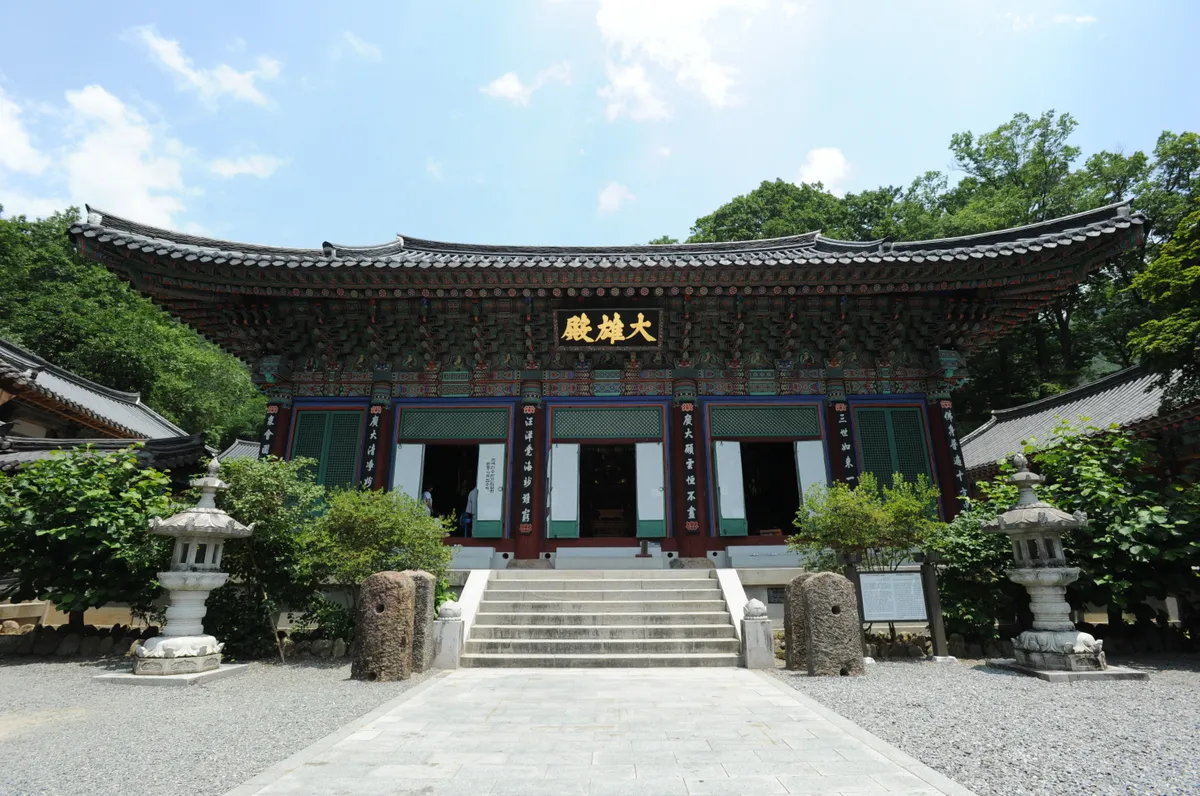
Daeungjeon Hall of Ssanggyesa Temple, Hadong
河東 雙磎寺 大雄殿
경상남도 하동군
Basic information
- Designation
- Treasure No.500
- Category
- Architecture
- Era
- 조선시대 후기
- Designated year
- 1968
- Location
- 하동군, 경상남도— 경남 하동군 화개면 쌍계사길 59, 쌍계사 (운수리)
- Coordinates
- 35.232553, 127.650818
AI Docent
Coming soonAn AI-generated, friendly retelling of this heritage site is available in Korean. An English version is on our roadmap — for now, please see the official description below.
Description
The Daeungjeon, the main hall of Ssanggyesa Temple* where the Buddha statue is enshrined, is believed to have been rebuilt at the time of the temple’s reconstruction in 1632. It is composed of five kan (a unit of measurement referring to the distance between two columns) at the front and three kan at the sides. The hall has a half-hipped roof which resembles the shape of the Chinese character 八 (pal, meaning ‘eight’). The eaves of the roof are supported by a bracket system consisting of brackets with decorations, placed both on and between the pillars. This building style is known as the profuse bracket system with its bracket materials stretched to the outside showing elegant curves and a traditional style. Two pairs of sliding doors are installed in the three kan in the center of the hall and two brackets are placed between pillars, while a pair of doors is installed in the other two kan of both ends and one bracket, between pillars. The ceiling is decorated with patterns of the Chinese character 井 (jeong, meaning ‘a well’) which serves to conceal the inside of the ceiling. A roof-shaped canopy enshrining the Buddha statue is installed above the altar. With its high pillars, the hall appears huge. It is regarded as an important cultural asset and as a source for research as it retains the shape and style of the wooden Buddhist architecture of the Joseon Dynasty. *Ssanggyesa Temple was originally called Okcheonsa Temple when it was built by two Buddhist monks, Daebihwasang and Sambeophwasang, in 722, the 21st year of the reign of King Seongdeok of the Unified Silla Dynasty. The name Ssanggyesa (‘two valleys’) originates from the geographical features around the temple, which was built at the meeting of two valleys. The temple was burnt down during the Japanese invasion of Korea in 1592 and was rebuilt by a Great Buddhist priest, Byeogamdaesa, in 1632, the 10th year of the reign of King Injo of the Joseon Dynasty.
Location
지도를 불러오는 중…
Have you visited this place?
Log in and verify your visit on-site via GPS to record a stamp in My Journey. (QR verification coming later.)
Images: KOGL (khs.go.kr) · Data source: Korea Heritage Service Open API (khs.go.kr)