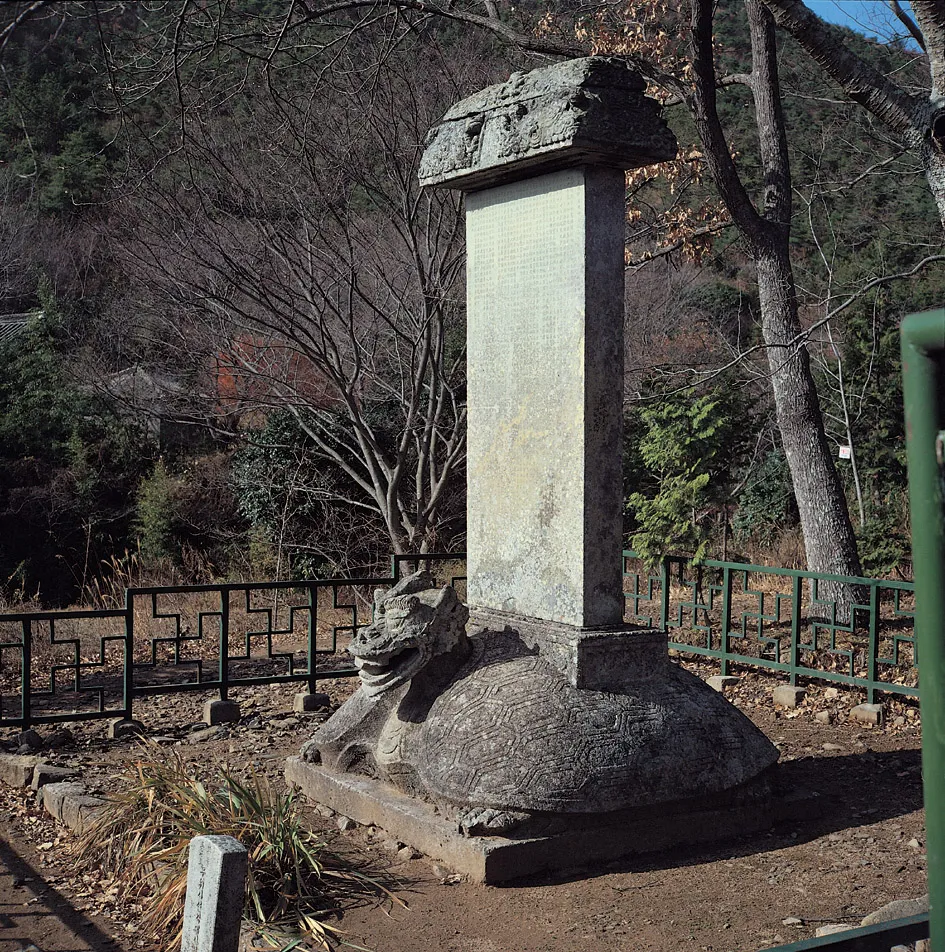
Stele of Buddhist Monk Seongak at Muwisa Temple, Gangjin
康津 無爲寺 先覺大師塔碑
전라남도 강진군
Basic information
- Designation
- Treasure No.507
- Category
- Books & Records
- Era
- 고려시대
- Designated year
- 1969
- Location
- 강진군, 전라남도— 전남 강진군 성전면 무위사로 308, 무위사 (월하리) / (지번)전남 강진군 성전면 월하리 1174
- Coordinates
- 34.738745, 126.686396
AI Docent
Coming soonAn AI-generated, friendly retelling of this heritage site is available in Korean. An English version is on our roadmap — for now, please see the official description below.
Description
This stele was built at Muwisa Temple to commemorate the life and achievements of the Buddhist Monk Seongak in 946, the first year of the reign of King Jeongjong of the Goryeo Dynasty. The temple is located on the southeast side of Wolchulsan Mountain in Gangjin, Jeollanam-do. It was originally called Gwaneumsa Temple, and was founded by Wonhyo, one of the greatest monk in Korea. The temple was renamed Muwisa when it was re-erected, for the fourth time, by Taegam in 1550, the fifth year of the reign of King Myeongjong of the Joseon Dynasty. Monk Seongak, one of the most eminent Buddhist monks of the late Silla period, spent eight years at Muwisa after 14 years of study in Tang Dynasty China. When he entered Nirvana at the age of 54 in 918, the first year of the reign of King Taejo of the Goryeo Dynasty, the king granted him the posthumous title Seongak, and named the pagoda 'Pyeongwangyeongtap Pagoda'. This stele was erected 28 years after Seongak's death. The stele is preserved very well, and consists of a pedestal, a main body, and a capstone. The turtle-shaped pedestal has a dragon head, looking very vivid and fierce and holding a magic bead in its mouth. A supporting stone that holds up the main body of the stele, placed on the center of the pedestal, is engraved with cloud and circular patterns. The main body carries an inscription about Seongak that was composed by Choe Eon-wi and inscribed by Yu Hun-yul in the square style of Chinese handwriting. The capstone has a three-tiered cornice engraved with lotus flower patterns. At the center of the capstone is a square space on which used to be written the name of the stele, but it is too defaced now to be recognizable. The capstone is carved with dragons in clouds, intended to lead the spirit of the dead to heaven. The stele is constructed with excellent workmanship, and shows a realistic and vivid sculpturing style compared to other steles.
Location
지도를 불러오는 중…
Have you visited this place?
Log in and verify your visit on-site via GPS to record a stamp in My Journey. (QR verification coming later.)
Images: KOGL (khs.go.kr) · Data source: Korea Heritage Service Open API (khs.go.kr)