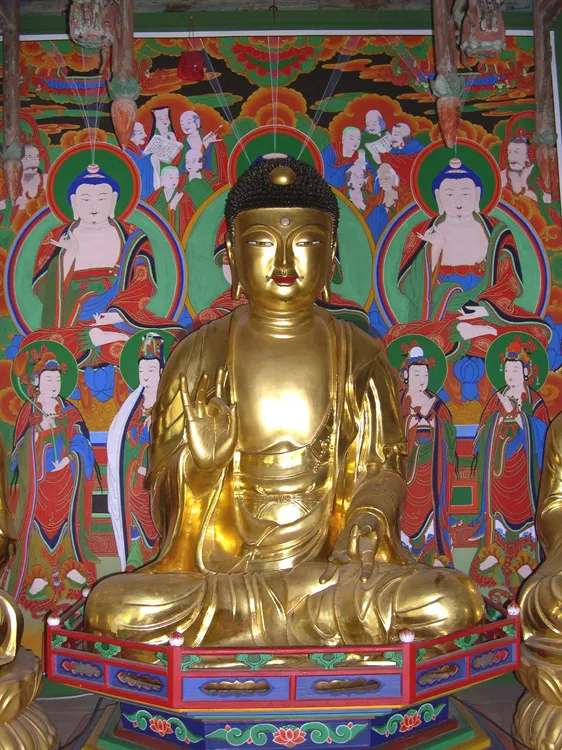
Seonguksa Geonchiramitayeoraejwasang Mit Reliquary Objects, Namwon
南原 善國寺 乾漆阿彌陀如來坐像 및 腹藏遺物
전북특별자치도 남원시
Basic information
- Designation
- Treasure No.1517
- Category
- Sculpture
- Designated year
- 2007
- Location
- 남원시, 전북특별자치도— 전북특별자치도 남원시 산성길 239(산곡동, 선국사 ) 선국사 * 복장유물 (김제 금산사 성보박물관)
- Coordinates
- 35.429258, 127.357772
AI Docent
Coming soonAn AI-generated, friendly retelling of this heritage site is available in Korean. An English version is on our roadmap — for now, please see the official description below.
Description
Dry-lacquered Buddha was a popular technique during the late Goryeo (918-1392) to the early Joseon (1392-1910) Period. This Dry-lacquered Seated Amitabha Buddha of Seonguksa has a majestic and well-proportioned body. The face looks gentle with coiled hair and two usnisas, symbols of the Buddha's wisdom and openness as an enlightened being, one on top of the head and one on the front. The image has round shoulders and a corpulent torso. In terms of the style of the robe, ornaments on the drapery and the ribbon tie on the undergarment, the image resembles the Gilt-bronze Seated Bhaisajyaguru Buddha of Janggoksa Temple, Cheongyang (Treasure No. 337, dated 1346) and the Gilt-bronze Seated Buddha of Munsusa Temple (Chungcheongnam-do Tangible Cultural Heritage No. 34, also dated 1346), which has been lost. The round face and the robe draped over the left shoulder are also compared with the Seated Wooden Amitabha, which was repaired in 1274 and then regilt in 1322; and another Wooden Seated Amitabha Buddha of Gaeunsa Temple (Treasure No. 930), which is believed to date to 1362 at the latest. In view of the scarcity of dry lacquer images and most of the extant images being bodhisattvas, this Amitabha is regarded as a highly valuable piece representing the carving style of the mid-14th century and the dry lacquer technique of the Goryeo Dynasty. The image was found to contain relics inside, some of which have been lost. All of the relics remaining today are documents from the late 14th to the late 15th centuries. They include stamped copies of the Dharani Sutra featuring a round conceptualized design of the Chinese character 梵, meaning Brahman. These are important for the study of Buddhist thought as well as printing and bibliographic history.
Location
지도를 불러오는 중…
Have you visited this place?
Log in and verify your visit on-site via GPS to record a stamp in My Journey. (QR verification coming later.)
Images: KOGL (khs.go.kr) · Data source: Korea Heritage Service Open API (khs.go.kr)