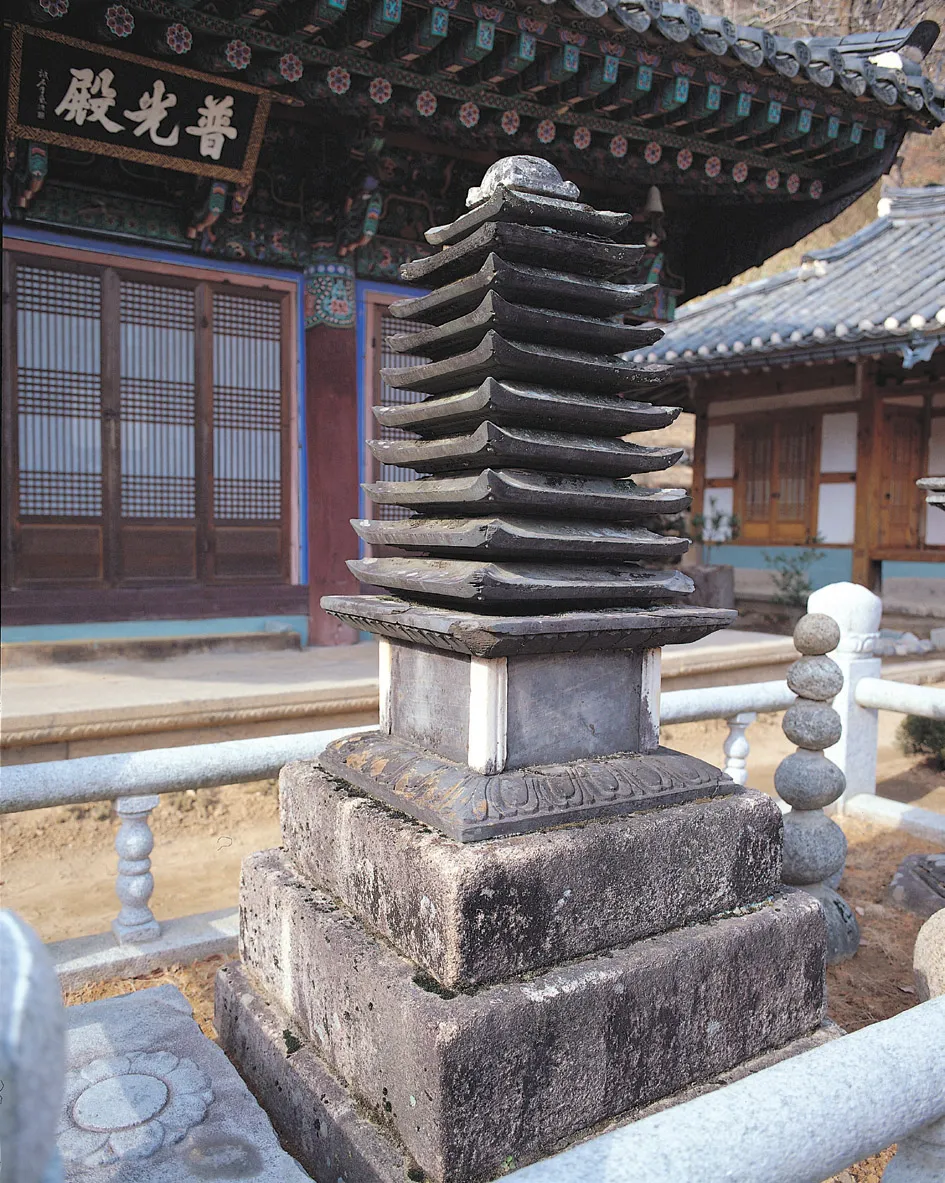
Multi-story Stone Pagoda and Stone Lantern at Wondangam Hermitage of Haeinsa Temple, Hapcheon
陜川 海印寺 願堂庵 多層石塔 및 石燈
경상남도 합천군
Basic information
- Designation
- Treasure No.518
- Category
- Sites & Pagodas
- Era
- 통일신라 후기
- Designated year
- 1970
- Location
- 합천군, 경상남도— 경남 합천군 가야면 해인사길 141-22 (치인리)
- Coordinates
- 35.801535, 128.092807
AI Docent
Coming soonAn AI-generated, friendly retelling of this heritage site is available in Korean. An English version is on our roadmap — for now, please see the official description below.
Description
This multi-story stone pagoda and lantern are located at Wondangam Hermitage of Haeinsa Temple, which was the birthplace of the national religion dedicated to the defense of the nation. The pagoda is a kind of cheongseok pagoda as its main body is made of clay-slate stone, which is the stone commonly used to make ink-stones. The foundation stone consists of three-layered granite on which the platform, the main body and the roof stone, all made of clay-slate stones, are placed. The bottom part of the single-layered platform is engraved with lotus flower patterns, while the four corners of the upper part are composed of marble pillars. The top stone of the platform is carved with lotus flower patterns. Unfortunately, the core stones of the main body are all missing, and only the roof stones for 10 stories remain. These stones are slim and horizontal, with low three-tiered cornices. The eaves turn swiftly upwards at the four edges. Of the upper part of the pagoda, only the finial base made of granite and the finial, which resembles an upturned bowl, remain. As the cheongseok pagoda became popular mainly during the Goryeo Dynasty, this one is believed to be one of the earliest such pagodas erected at the end of the Silla Dynasty. The stone lantern which stands next to the pagoda was built around the same time as it. It consists of a hexagonal foundation stone, a lower base, a middle base, and a roof stone. The lower base and the roof stone are made of clay-slate stones, while the others are made of granite. At present, the light chamber under the roof stone is missing. The middle base, which is long and slim, is inscribed with the Chinese characters, 上 (sang, meaning ‘up’) and 下 (ha, meaning ‘down’). The upper side of the hexagonal roof stone is horizontal and a top ornament, a cylindrical stone, is set on the top of the lantern.
Location
지도를 불러오는 중…
Have you visited this place?
Log in and verify your visit on-site via GPS to record a stamp in My Journey. (QR verification coming later.)
Images: KOGL (khs.go.kr) · Data source: Korea Heritage Service Open API (khs.go.kr)