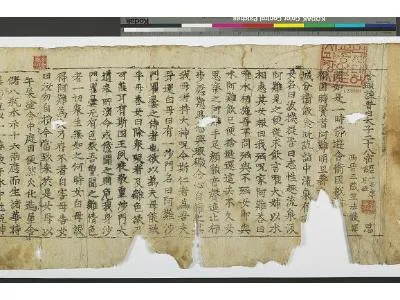
Chojobon Saduganjiniltaejaisippalsugyeong
初雕本 舍頭諫晉日太子二十八宿經
서울특별시 서대문구
Basic information
- Designation
- Treasure No.1528
- Category
- Books & Records
- Designated year
- 2007
- Location
- 서대문구, 서울특별시— 서울 서대문구 연세로 50, 중앙도서관 (신촌동,연세대학교)
- Coordinates
- 37.565534, 126.938418
AI Docent
Coming soonAn AI-generated, friendly retelling of this heritage site is available in Korean. An English version is on our roadmap — for now, please see the official description below.
Description
This sutra, contained in the first edition of the Tripitaka Koreana compiled in the 11th century during the Goryeo Dynasty, has the original title Sardula-karna Vadana but is known in Korean as Sadugan Jiniltaeja isippalsugyeong (literally the Sardula-karna Prince Jinil's Sutra of 28 Constellations). It was translated into Chinese by Central Asian script translator Zhu Fahu (Dharmaraksa) during Western Jin. Also known as Huer jing (Tiger's Ears Sutra, or Hoigyeong in Korean), it was contained in the second edition of Tripitaka Koreana under the shortened title Sadugan taeja isippalsugyeong. The sutra mainly concerns the desire of a low-class Indian woman and the equality of the four castes as well as astronomy, divination and constellations. As it explains the Indian caste system in detail, the sutra is useful for understanding ancient Indian society. This scroll-style book, in the possession of Yonsei University Library, consists of 38 pages, each page measuring 46.3cm in width, and is designed to be rolled around a handle. The cover has been partially damaged near the bottom. The scroll is made of undyed mulberry paper and the band of coarse hemp. The cover has an abbreviated title, Sadugan isippalsugyeong, followed by a table of contents. Under the Sutra title is the Chinese character ‘思’ used for pagination. The full title comes on the following page and is accompanied with “a.k.a Hoigyeong.” Each page has single lines along the top and bottom edges, a style often found on both rolling scroll and folding scroll books. The first chapter has 22 lines on each page, but from the second chapter on, each page has 23 lines. Each line has 14 Chinese characters. The second edition of the Tripitaka Koreana has 17 characters on each line. Compared with the Tripitaka of Northern Song and the second Tripitaka Koreana edition, the regular script type looks no less solid and neat. This is a valuable research material for the two Korean editions of the Tripitaka as well as Buddhist and bibliographical studies.
Location
지도를 불러오는 중…
Have you visited this place?
Log in and verify your visit on-site via GPS to record a stamp in My Journey. (QR verification coming later.)
Images: KOGL (khs.go.kr) · Data source: Korea Heritage Service Open API (khs.go.kr)