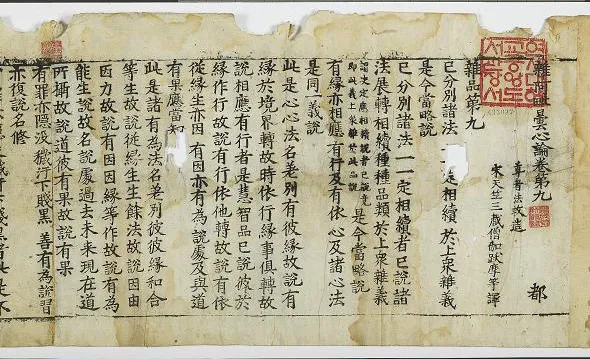
Chojobon Jababidamsimron Gwon9
初雕本 雜阿毗曇心論 卷九
서울특별시 서대문구
Basic information
- Designation
- Treasure No.1529
- Category
- Books & Records
- Designated year
- 2007
- Location
- 서대문구, 서울특별시— 서울 서대문구 연세로 50, 중앙도서관 (신촌동,연세대학교)
- Coordinates
- 37.565534, 126.938418
AI Docent
Coming soonAn AI-generated, friendly retelling of this heritage site is available in Korean. An English version is on our roadmap — for now, please see the official description below.
Description
This is Volume 9 from the total 11 volumes of treatises entitled Abhidharma sara prakirnaka Sastra (Heart of Scholasticism) written by the ancient Indian monk Dharmatrata, translated into Chinese by Samghavarman in 435 during the Liu Song period, and printed by the Directorate of Tripitaka Publications of the Goryeo Dynasty in the 11th century. It was a major text of Sarvastivada, an early Hinayana School of Buddhism, which was literally the sect that speaks of the existence of everything. The book consists of a preface and 11 chapters on The Elements, Formations, Actions, Contaminants, Nobility, Knowledge, Concentration, Sutra, Miscellany, Investigations and Discussion. The present volume is Chapter Nine on Miscellany, which discusses non-interrelation, three unconditioned matters, nine results and divine feet, among other subjects. The scroll carries the book title, the volume number, the Chinese character ‘都’ used for pagination, and the names of the author and the translator. The cover page has 22 lines while text pages have 23 lines, each line with 14 Chinese characters. The text pages have no boundary lines and the abbreviated book title between pages cannot be checked as space between the pages is very small. At the end of the scroll is a wooden handle, which is 30.3cm long and 0.8cm in diameter, and painted with vermilion. Given the bamboo bookmark connected to the middle part of the scroll with a cloth string, the scroll appears to maintain its original state of binding. This is an important source material for study of the first edition of the Tripitaka Koreana as well as early Buddhism and bibliographical development.
Location
지도를 불러오는 중…
Have you visited this place?
Log in and verify your visit on-site via GPS to record a stamp in My Journey. (QR verification coming later.)
Images: KOGL (khs.go.kr) · Data source: Korea Heritage Service Open API (khs.go.kr)