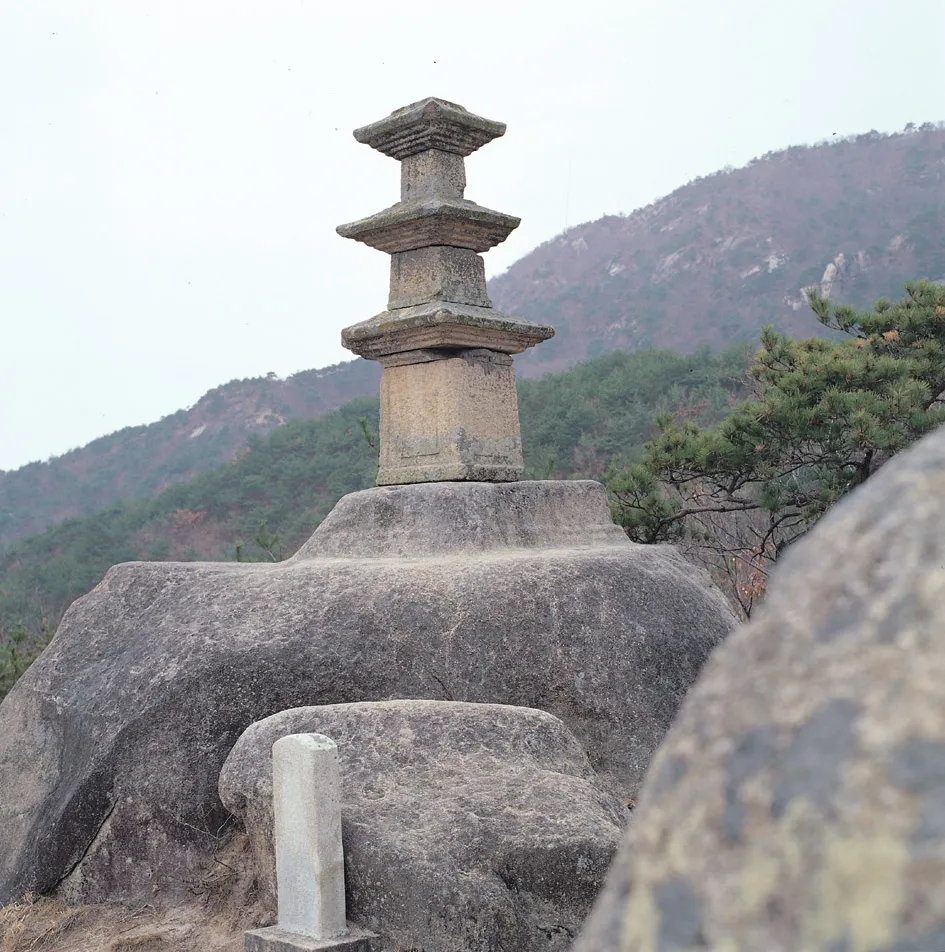
Three-story Stone Pagoda at Mangtapbong Peak of Yeongguksa Temple, Yeongdong
永同 寧國寺 望塔峰 三層石塔
충청북도 영동군
Basic information
- Designation
- Treasure No.535
- Category
- Sites & Pagodas
- Era
- 고려시대 중기
- Designated year
- 1971
- Location
- 영동군, 충청북도— 충북 영동군 양산면 누교리 산139-1번지 영국사
- Coordinates
- 36.157099, 127.613140
AI Docent
Coming soonAn AI-generated, friendly retelling of this heritage site is available in Korean. An English version is on our roadmap — for now, please see the official description below.
Description
Yeongguksa Temple was probably built during the late Unified Silla period. State Preceptor Wongak likely reconstructed it in the 12th century (reign of King Myeongjong of Goryeo). During the reign of King Gojong of Goryeo, the king ordered An Jong-pil to rebuild the pagoda, the stupa, and the main Buddhist hall and to name the temple Gukcheongsa. Later, King Gongmin renamed it Yeongguksa. This pagoda is found on a small peak called Mangtapbong located 500m east of Yeongguksa Temple. It is composed of a stylobate made of a large granite rock and a three-tier main body. To make the stylobate, the top of the rock was flattened, and the natural part coming out of it in its middle was used. The stylobate was then completed with the shape of pillars and eyes engraved on it. The main body was put on the stylobate without any pedestal. The upper part of the main body is narrower than its lower part. The body stone on the first floor has patternless door shapes carved in relief on its four sides. These doors look like picture frames whose upper and lower parts project. The roof stone has a gentle slope on its gutter, with the rafter having a straight line that is slightly raised at the end. The roof stone has a five-tier base on the first floor and a three-tier base on the second and third floors. The pagoda does not have a regular successive diminution ratio, but the narrow top of the body stone makes it look relatively stable. It partially shows the simplified style of Goryeo’s stone pagodas with its single-tier stylobate and omission of top stone on the stylobate. Considering the style and carving techniques of each of its part, the pagoda was probably built around the 12th century in the middle of the Goryeo period.
Location
지도를 불러오는 중…
Have you visited this place?
Log in and verify your visit on-site via GPS to record a stamp in My Journey. (QR verification coming later.)
Images: KOGL (khs.go.kr) · Data source: Korea Heritage Service Open API (khs.go.kr)