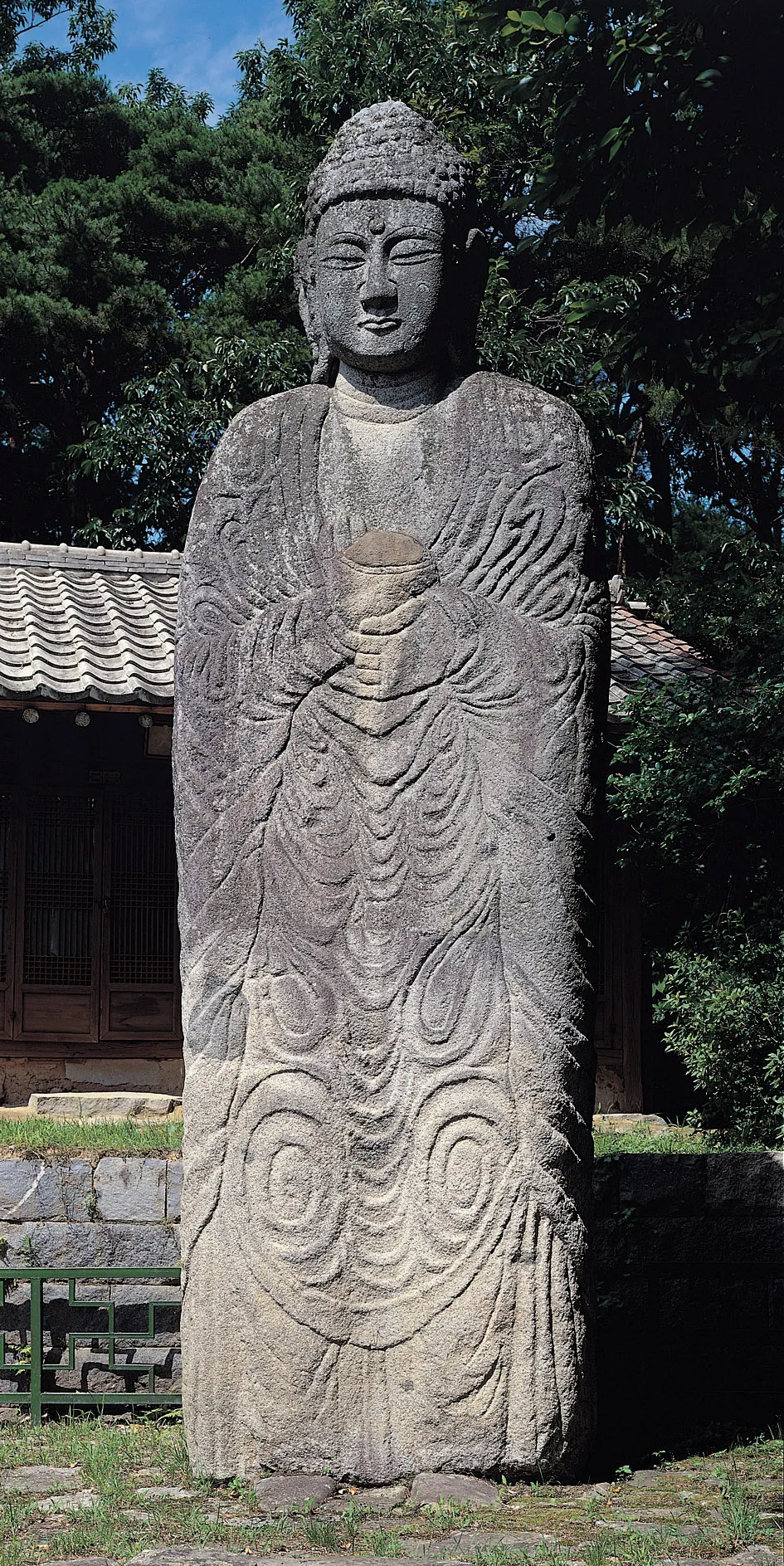
Stone Standing Bhaisajyaguru Buddha in Pyeongchon-ri, Asan
牙山 坪村里 石造藥師如來立像
충청남도 아산시
Basic information
- Designation
- Treasure No.536
- Category
- Sculpture
- Era
- 고려시대 초기
- Designated year
- 1971
- Location
- 아산시, 충청남도— 충남 아산시 송악면 평촌리 산1-1번지
- Coordinates
- 36.744382, 127.008247
AI Docent
Coming soonAn AI-generated, friendly retelling of this heritage site is available in Korean. An English version is on our roadmap — for now, please see the official description below.
Description
This Buddha at an ancient temple site, located at the mid-slope of a mountain in Pyeongchon-ri, was carved out of a large granite block. The statue has an upper body that is too short, compared to the lower body. In spite of the slightly disproportionate appearance, its finely rendered face and drapery make this sculpture a worthy piece of craftsmanship. The head is covered with small hair whorls and has a large top knot (usnisa) in the middle. The elongated earlobes hanging down to the shoulders add to the merciful air of this Buddha figure. The small delicate mouth with thin lips contrasts with the rest of his features. The two hands are gathered at the chest level, holding a medicine jar; the insignia of Bhaisajyaguru, the Buddha of healing and medicine, popularly known as the medicine Buddha. The robe drapes down from the both shoulders all the way to the ankles. The pleats on the left and right sides are in symmetric positions; a rather unusual detail. The garment folds in the upper half of the body are rendered with incised lines that run parallel to one another and are placed at close and regular intervals. The pleats in the lower body form the overall shape of the letter ‘U’ with the robe draping in three separate strands on the front. Over the two knees, the folds are rendered in the shape of a concentric circle. This appears as the result of an extreme formalization of a style that was once popular during the Unified Silla period. Folds in concentric shape are rather rare and are only occasionally seen in Three Kingdoms-period or Unified Silla-period Buddha figures such as the Maitreya triad of Samhwaryeong or the Stone Standing Buddha in Seokgyo-ri, Yeongju (Treasure No. 116). The realistic face is also an element harking back to the Unified Silla period. However, overly stylized elements such as the garment folds at regular intervals and in symmetric positions, short neck and somewhat hunched shoulders and the steep upright position suggest that this sculpture dates from early Goryeo.
Location
지도를 불러오는 중…
Have you visited this place?
Log in and verify your visit on-site via GPS to record a stamp in My Journey. (QR verification coming later.)
Images: KOGL (khs.go.kr) · Data source: Korea Heritage Service Open API (khs.go.kr)