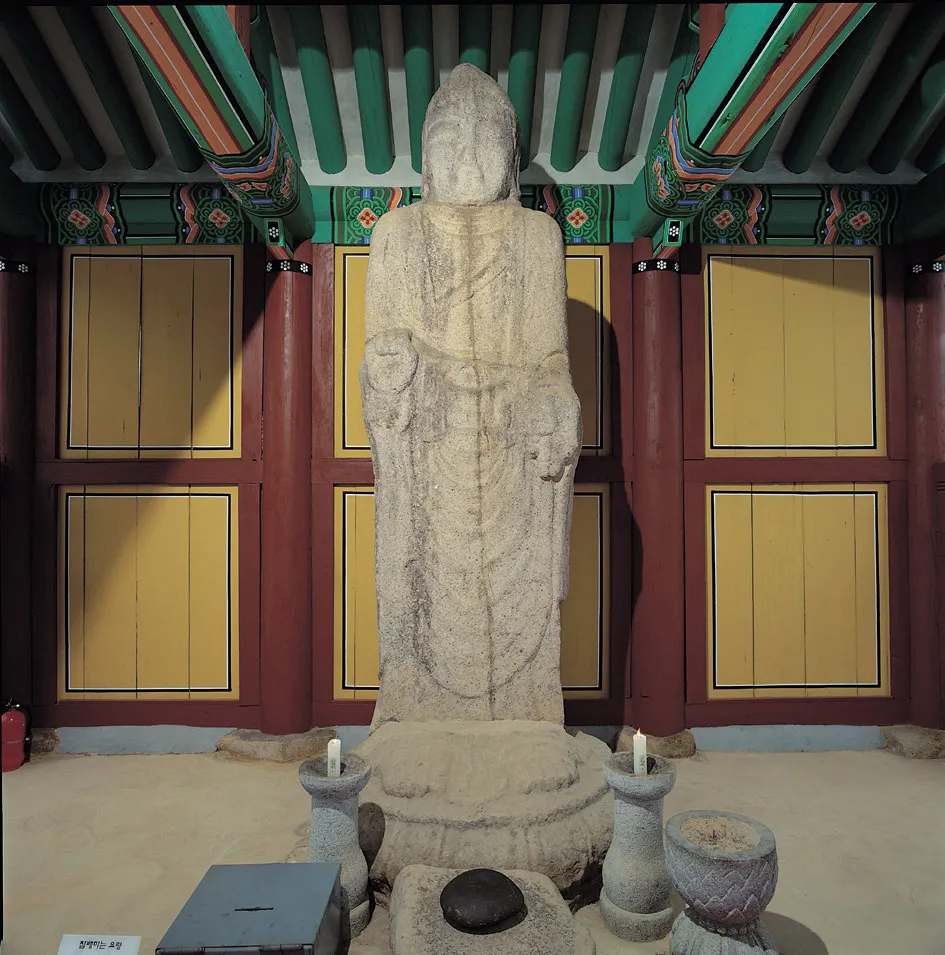
Stone Standing Buddha in Multae-ri, Jecheon
堤川 勿台里 石造如來立像
충청북도 제천시
Basic information
- Designation
- Treasure No.546
- Category
- Sculpture
- Era
- 고려시대 초기
- Designated year
- 1971
- Location
- 제천시, 충청북도— 충청북도 제천시 청풍면 물태리 산 6-20
- Coordinates
- 37.004048, 128.171799
AI Docent
Coming soonAn AI-generated, friendly retelling of this heritage site is available in Korean. An English version is on our roadmap — for now, please see the official description below.
Description
The stone Buddha estimated to date from the 10th century was moved from its original location in Eup-ri, Cheongpung-myeon, which was flooded following the construction of Chungju Dam, to its current location outside Daegwangsa Temple on a bank of the Cheongpunggang River. The Buddha figure has an unusually small usnisa at the top of the head and a temperate-looking square-shaped face. The eyes in thin slits but with thick fleshy eyelids, wide nose and the distinct philtrum make this figure a befitting portrayal of a Buddha. The two elongated ears droop to the shoulders, and the neck shows three lines that are a somewhat stilted rendering of this insignia of Buddhahood. The robe covers both shoulders and comes across as thick, as no body lines are revealed through it. A sash for holding up the lower garment is tied into a knot at the waist level. Below the waistline, the garment drapes rather naturally, forming folds in the overall shape of the letter ‘U.’ The right hand is held up with bent fingers. The left hand hangs down along the side of the body with stretched fingers, and the palm faces outward. The original pedestal, found at a distance of about 3m from where the statue was discovered, is octagonal in shape with lotus flowers carved on all lateral sides. While the robust shoulders of this statue and good sense of volume it conveys evoke the vigorous energy of Unified Silla Buddhist sculpture, the stylized rendering of the lines at the neck, unrealistic hands and the equally unnatural depiction of the body suggest that it is almost certainly a Goryeo-period work.
Location
지도를 불러오는 중…
Have you visited this place?
Log in and verify your visit on-site via GPS to record a stamp in My Journey. (QR verification coming later.)
Images: KOGL (khs.go.kr) · Data source: Korea Heritage Service Open API (khs.go.kr)