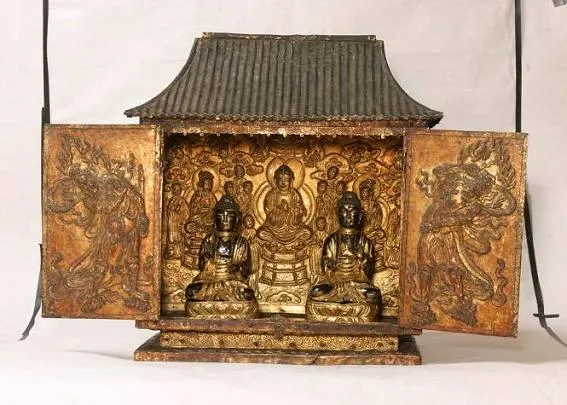
Cheoneunsa Geumdongbulgam, Gurye
求禮 泉隱寺 金銅佛龕
전라남도 구례군
Basic information
- Designation
- Treasure No.1546
- Category
- Craft
- Era
- 14세기
- Designated year
- 2008
- Location
- 구례군, 전라남도— 전남 구례군 광의면 노고단로 209, 천은사 (방광리)
- Coordinates
- 35.273740, 127.476285
AI Docent
Coming soonAn AI-generated, friendly retelling of this heritage site is available in Korean. An English version is on our roadmap — for now, please see the official description below.
Description
Buddhist portable shrines, carved out of wood, stone or metal, were for personal or mobile worship rituals. With Buddhist images enshrined in a small ornate space, they often provide useful glimpses of architectural and sculptural styles of the time they were made. This portable shrine, with a height of 43.3 centimeters, houses two gilt-bronze Buddhas against the main wall, on which the Vairocana triad and the ten disciples of the historic Buddha are carved in relief. It is designed to be opened fully with two hinged front doors, each adorned inside with an elaborate image of Vajrapani, the dynamic protector of Buddhism, holding a sword. The Vairocana is depicted sitting on an octagonal lotus throne, with both hands raised to the chest in the vajra mudra, or the gesture symbolizing wisdom, typical of the Buddha of Great Illumination. The elegant face and body and the exquisite lotus pedestal all display refined carving technique. The side walls are carved with gorgeous floral patterns and the ceiling has colorful decorative designs, expressing the beautiful world of the Buddha. Compared with the Vairocana and other figures carved on the wall, the two gilt-bronze Buddhas are rather stiff in spite of their elegant faces and bodies. Both images sit on a lotus pedestal in the typical late Goryeo to early Joseon style, which consist of two tiers of lotus petals, facing up and down, respectively. Generally the relief images on the wall have notably fluid lines and gentle expressions. The two Vajrapani figures add to the overall energetic and lively feeling. Commonly known to have been the tutelary Buddha of Buddhist Monk Naong (1320-1376), the portable shrine has an inscription on the back wall, which notes that the altar was made by Kim Chi and Bak Eo-san, the statuettes were carved by Sinseung, and four other monks participated in the work, which was funded by a man named Bak and his wife. The portable shrine is a significant object for research of Buddhist icons. It embodies faith in the threefold body of the Buddha, or Trikaya, and the Buddha of the past, present and future. The portable shrine of gilt-bronze Buddhas also shows important aspects of the sculpture, painting, metalwork, architecture and decorative patterns of the late Goryeo to early Joseon Dynasty. Therefore, in March 2008 it was promoted from Jeollanam-do Tangible Cultural Heritage No. 29 to Treasure No. 1546.
Location
지도를 불러오는 중…
Have you visited this place?
Log in and verify your visit on-site via GPS to record a stamp in My Journey. (QR verification coming later.)
Images: KOGL (khs.go.kr) · Data source: Korea Heritage Service Open API (khs.go.kr)