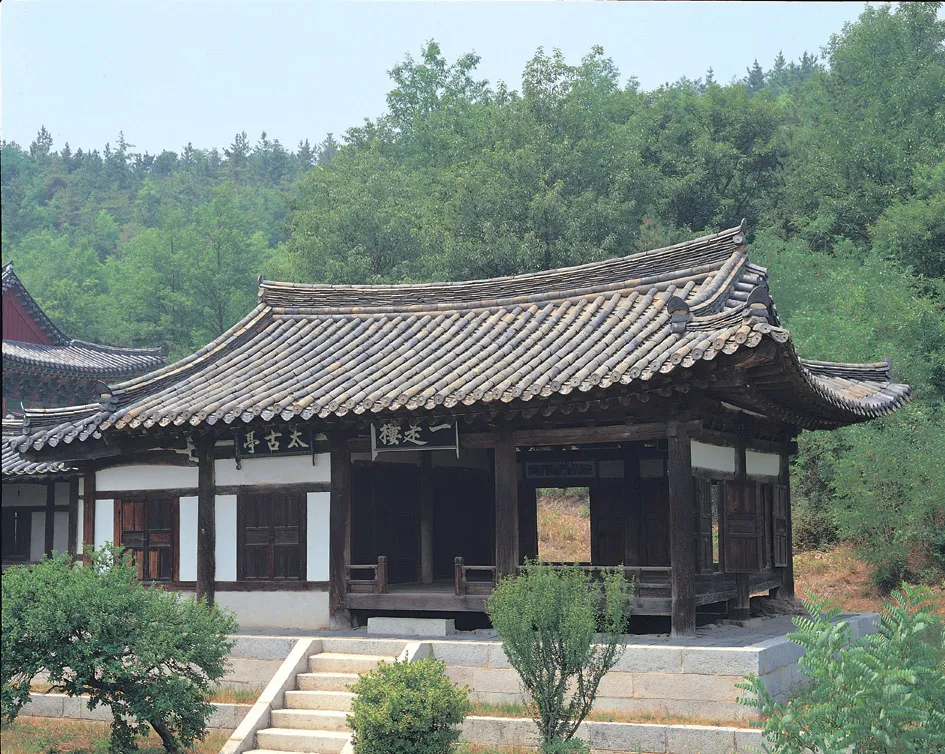
Taegojeong House, Dalseong
達城 太古亭
대구광역시 달성군
Basic information
- Designation
- Treasure No.554
- Category
- Architecture
- Era
- 조선 성종 10년(1479)
- Designated year
- 1971
- Location
- 달성군, 대구광역시— 대구광역시 달성군 육신사길 64(하빈면, 육신사)
- Coordinates
- 35.911303, 128.416704
AI Docent
Coming soonAn AI-generated, friendly retelling of this heritage site is available in Korean. An English version is on our roadmap — for now, please see the official description below.
Description
Taegojeong was built in 1479 (10th year of King Seongjong’s reign) by Bak Il-san, the grandson of Bak Paeng-nyeon as an outbuilding to a house. The building was consumed by fire during the Japanese Invasion of 1592 (Imjin Waeran) with only a small portion of it surviving. It was later rebuilt in 1614 (6th year of King Gwanghaegun’s reign). The building is also referred to as “Ilsiru.” Inside the open foyer of the house, a wooden tablet carved with a poem in Sino-Korean characters by Yun Du-su who arrived there as a wartime plenipotentiary (Chichalsa) during the first Japanese Invasion (1592-1596) is visible. Next to the wooden tablet are a series of framed calligraphies by Ming-dynasty Chinese army officials who fought alongside Joseon soldiers during the Second Japanese Invasion (1596-1598). The house is built on a rectangular platform and extends 4 kan (kan: a unit of measurement referring to the distance between two columns) on the front and two on the side. The two-kan space on the east side is occupied by the open foyer, and the remaining two-kan space on the west side accommodates a room. The foyer is completely open on the front, but has doors on the side and the back. Between the two pillars on the front side of the foyer, there is a wooden railing. The room on the west side, an ondol-heated room, has an adjoining kitchen at a spot generally reserved for a simple fireplace. This is a rather unusual feature given that kitchens in a Joseon home are rarely situated at a far end of a house. Although not impressive in size, the house has tastefully-finished details and is furnished with finely-crafted furniture.
Location
지도를 불러오는 중…
Have you visited this place?
Log in and verify your visit on-site via GPS to record a stamp in My Journey. (QR verification coming later.)
Images: KOGL (khs.go.kr) · Data source: Korea Heritage Service Open API (khs.go.kr)