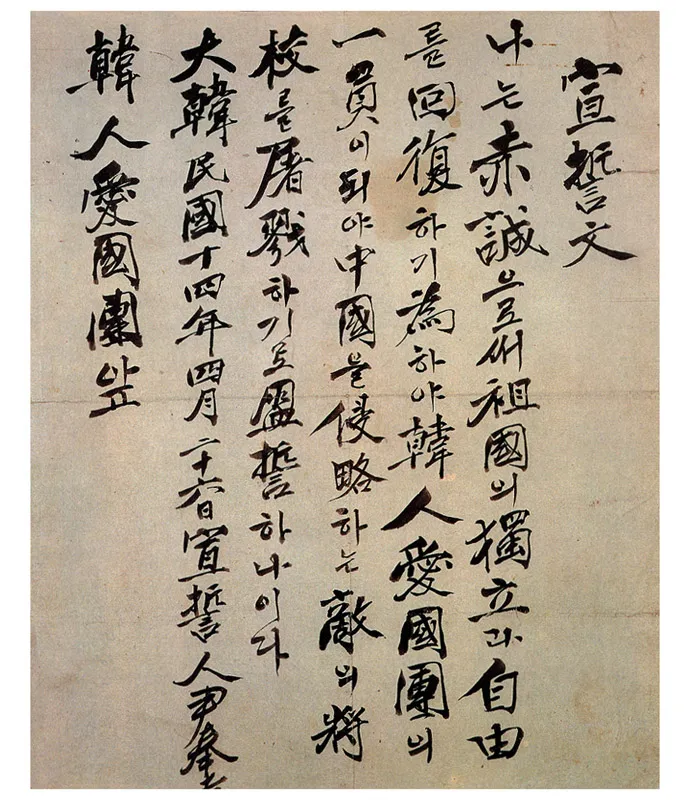
Artifacts Used by Yun Bong-gil
尹奉吉義士 遺品(1972-1)
서울특별시 용산구
Basic information
- Designation
- Treasure No.568-1
- Category
- Books & Records
- Era
- 1932년
- Designated year
- 1972
- Location
- 용산구, 서울특별시— 서울 용산구 서빙고로 137, 국립중앙박물관 (용산동6가)
- Coordinates
- 37.524041, 126.980350
AI Docent
Coming soonAn AI-generated, friendly retelling of this heritage site is available in Korean. An English version is on our roadmap — for now, please see the official description below.
Description
This pledge of commitment is one of the surviving personal documents of Yun Bong-gil, the author of the Shanghai bombing at Hongkou Park (today’s Luxun Park) in Shanghai against the leadership of the Japanese Imperial Army (April 29, 1932). This hand-written pledge was drafted by him at the time of joining Haninaegukdan, the Korean independence activist organization run by Kim Gu. Born at Saryang-ri, Yesan-gun, Chungcheongnam-do, Yun Bong-gil attended Deoksan Elementary School and later Ochi seosuk. When he was nineteen years of age, he set up a night school in his hometown to educate its rural residents. During the following year, the twenty year-old Yun Bong-gil created a book club (‘Gakgokdokseohoe’) and authored Nongmin dokbon, an instructional book for educating the peasantry. At the age of twenty-two, he started a rural community movement and founded Woljinhoe as its headquarters. When he was twenty-three years of age, as the oppression of independence activists grew severer, Yun Bong-gil left Korea for China. In 1931, he joined Haninaegukdan, an organization led by Kim Gu. On April 29, 1932, he threw a bomb at Japanese army officials holding an event celebrating Japan’s war victories at Hongkou Park in Shanghai, killing or wounding several members of the army leadership, including the supreme commander Yoshinori Shirakawa. Yun Bong-gil was arrested at the scene. He was court martialed and received a death sentence. After his trial and sentencing, Yun Bong-gil was transferred to Japan in November of the same year and was executed on December 19, 1932 in an Osaka prison.
Location
지도를 불러오는 중…
Have you visited this place?
Log in and verify your visit on-site via GPS to record a stamp in My Journey. (QR verification coming later.)
Images: KOGL (khs.go.kr) · Data source: Korea Heritage Service Open API (khs.go.kr)