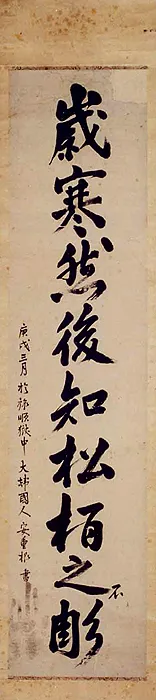
Calligraphy by An Jung-geun
安重根義士 遺墨 - 歲寒然後知松栢之不彫
경기도 파주시
Basic information
- Designation
- Treasure No.569
- Category
- Books & Records
- Era
- 1910년
- Designated year
- 1972
- Location
- 파주시, 경기도— 경기도 파주시 헤이리로 30 (탄현면, 국립민속박물관 파주관)
- Coordinates
- 37.786670, 126.693918Kakao address conversion
AI Docent
Coming soonAn AI-generated, friendly retelling of this heritage site is available in Korean. An English version is on our roadmap — for now, please see the official description below.
Description
Machine-translatedThis English description was machine-translated and may contain inaccuracies. Refer to the original Korean text for details.
The calligraphic work 'Ahn Jung-geun's Ink Brushwork—Seihan Yeonhu Ji Songbaek Ji Bujo' (After the severe cold comes one learns the pine and cypress do not wither) represents a collection of ink brushwork created by the patriot Ahn Jung-geun (1879-1910) while imprisoned in Lüshun Prison from the time of his arrest following the assassination of Itō Hirobumi at Harbin Station in Manchuria on October 26, 1909, until his death on March 26, 1910. These works, designated as a group, were written in February and March 1910, with notations on the left side reading 'Gyeongseul second (or third) month, in Lüshun Prison, written by Ahn Jung-geun, a Korean national' followed by palm-print seals. The content of the brushwork is highly instructional, drawn from passages in the Analects and Records of the Grand Historian, expressing the writer's inner sentiments, critiques of worldly changes, warnings against Japan, and dedications for individuals' personal appellations. Most of the ink brushwork was presented to Japanese prosecutors, prison guards, and others during his imprisonment. Among these works, one piece received by Orita Tadasu, who served as a prison guard after the Russo-Japanese War, was later transferred to his nephew Orita Kanji during the family's return to Japan after liberation on August 15, and was donated to Dankook University on February 20, 1989. Another piece was donated to the Ahn Jung-geun Memorial Society by the grandson of a prison official who served during Ahn's detention. The phrase 'Seihan Yeonhu Ji Songbaek Ji Bujo' means 'Only after severe cold comes one knows that the pine and cypress do not wither,' expressing resilience through natural metaphor.
Location
지도를 불러오는 중…
Have you visited this place?
Log in and verify your visit on-site via GPS to record a stamp in My Journey. (QR verification coming later.)
Images: KOGL (khs.go.kr) · Data source: Korea Heritage Service Open API (khs.go.kr)