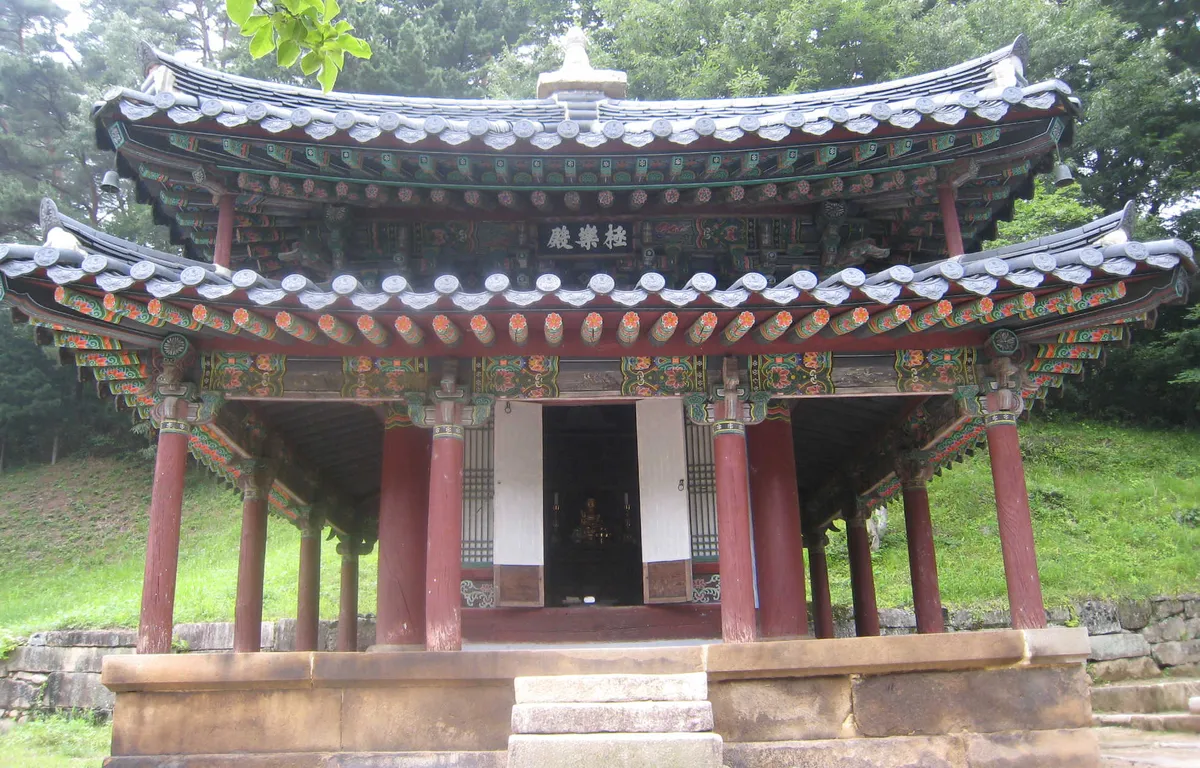
Bongamsa Geungnakjeon Hall, Mungyeong
聞慶 鳳巖寺 極樂殿
경상북도 문경시
Basic information
- Designation
- Treasure No.1574
- Category
- Architecture
- Era
- 조선시대
- Designated year
- 2008
- Location
- 문경시, 경상북도— 경북 문경시 가은읍 원북길 313 (원북리)
- Coordinates
- 36.700207, 128.006462
AI Docent
Coming soonAn AI-generated, friendly retelling of this heritage site is available in Korean. An English version is on our roadmap — for now, please see the official description below.
Description
Geungnakjeon Hall, meaning the “Paradise Hall,” of Bongamsa Temple has a unique appearance in that it resembles a two-story structure. It is actually a single-story pavilion with a full-bay verandah on all four sides that support the upper roof, but with different column arrangements on the two levels. King Gyeongsun (r. 927-935), the last ruler of Silla, is said to have taken refuge here during the chaotic final years of the declining kingdom. Inside the hall is a sign reading “Eopilgak,” meaning that it houses a work handwritten by the king. A ridge-end roof tile is carved with “16th Year of Showa,” which suggests that the roof was repaired in 1941, during the Japanese Colonial Period. Along with Borimsa Temple in Jangheung, Bongamsa is one of the two remaining temples that served as headquarters of the Nine Mountain Schools of Zen Buddhism from late Silla to early Goryeo. Geungnakjeon is also one of the oldest temple halls in the country, which retains features of early temple architecture. In view of its location and appearance, however, the present hall was very likely rebuilt sometime from the mid- to late Joseon Dynasty. But the base and foundation stones are older, possibly dating to Goryeo. The hall is recognized for its remarkable historic, artistic and academic value as evidenced by its ingenious appearance, architectural technology and ornamental painting on wooden elements.
Location
지도를 불러오는 중…
Have you visited this place?
Log in and verify your visit on-site via GPS to record a stamp in My Journey. (QR verification coming later.)
Images: KOGL (khs.go.kr) · Data source: Korea Heritage Service Open API (khs.go.kr)