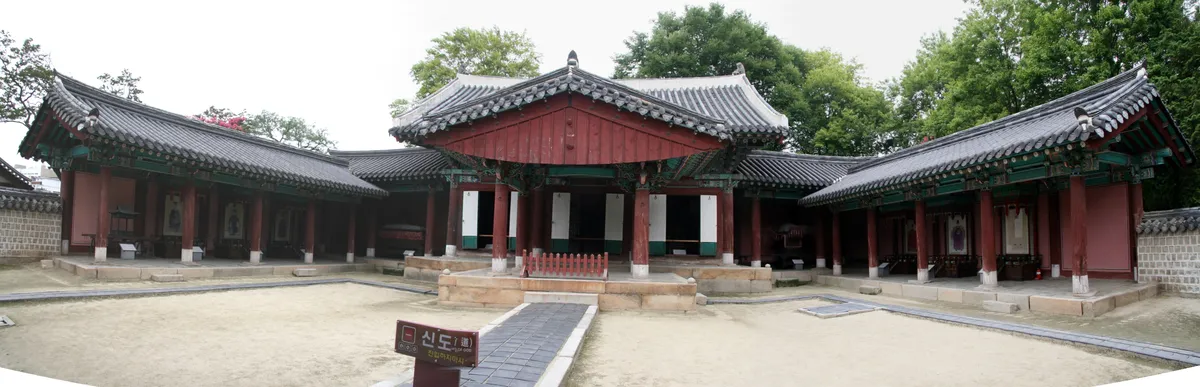
Gyeonggijeon Jeong Hall, Jeonju
全州 慶基殿 正殿
전북특별자치도 전주시
Basic information
- Designation
- Treasure No.1578
- Category
- Architecture
- Era
- 조선시대
- Designated year
- 2008
- Location
- 전주시, 전북특별자치도— 전북 전주시 완산구 풍남동3가 102번지
- Coordinates
- 35.815302, 127.149772
AI Docent
Coming soonAn AI-generated, friendly retelling of this heritage site is available in Korean. An English version is on our roadmap — for now, please see the official description below.
Description
Gyeonggijeon Shrine houses a portrait of King Taejo (1335-1408, r. 1392-1398), the founding ruler of the Joseon Dynasty. Erected in 1410, the shrine was initially called Eoyongjeon (“Royal Visage Shrine”) or Taejojinjeon (“True Visage Shrine of King Taejo”), but was renamed Gyeonggijeon (“Shrine of Felicitous Foundation”) in 1442, the 24th year of King Sejong’s reign. It was burned down in 1597, during the second Japanese Invasion, and was rebuilt in 1614. It went through overall repairs in 1872, when a new reproduction of King Taejo’s Portrait was made and enshrined there. This Portrait of King Taejo is Treasure No. 931. The Main Hall, or Jeongjeon in Korean, is a five-beam structure covered with a gabled roof, featuring double eaves and elaborate triple-bracket sets in the mid-Joseon style. An open ceremonial pavilion forms the facade of the Main Hall, its roof gables constituting the front of the roof. Both buildings have plain round columns and stand on granite foundations. Inside the Main Hall, two tall pillars 5.8 meters high support the horizontal beams, and the side columns are also tall enough to support the main crossbeams. The neat, solid roof structure, built of carefully proportioned and skillfully carved members, demonstrates precise joining and fitting techniques as well as adroit carving skills. The gorgeous coffered ceiling enhances the dignified ambience of the royal portrait hall, distinguishing it from other Confucian buildings. The solemn atmosphere is further emphasized by the spirit road stretching from the inner spirit gate to the Main Hall, the incense burners and the colonnaded corridors flanking the elegant complex of the Main Hall, and an open ceremonial pavilion.
Location
지도를 불러오는 중…
Have you visited this place?
Log in and verify your visit on-site via GPS to record a stamp in My Journey. (QR verification coming later.)
Images: KOGL (khs.go.kr) · Data source: Korea Heritage Service Open API (khs.go.kr)