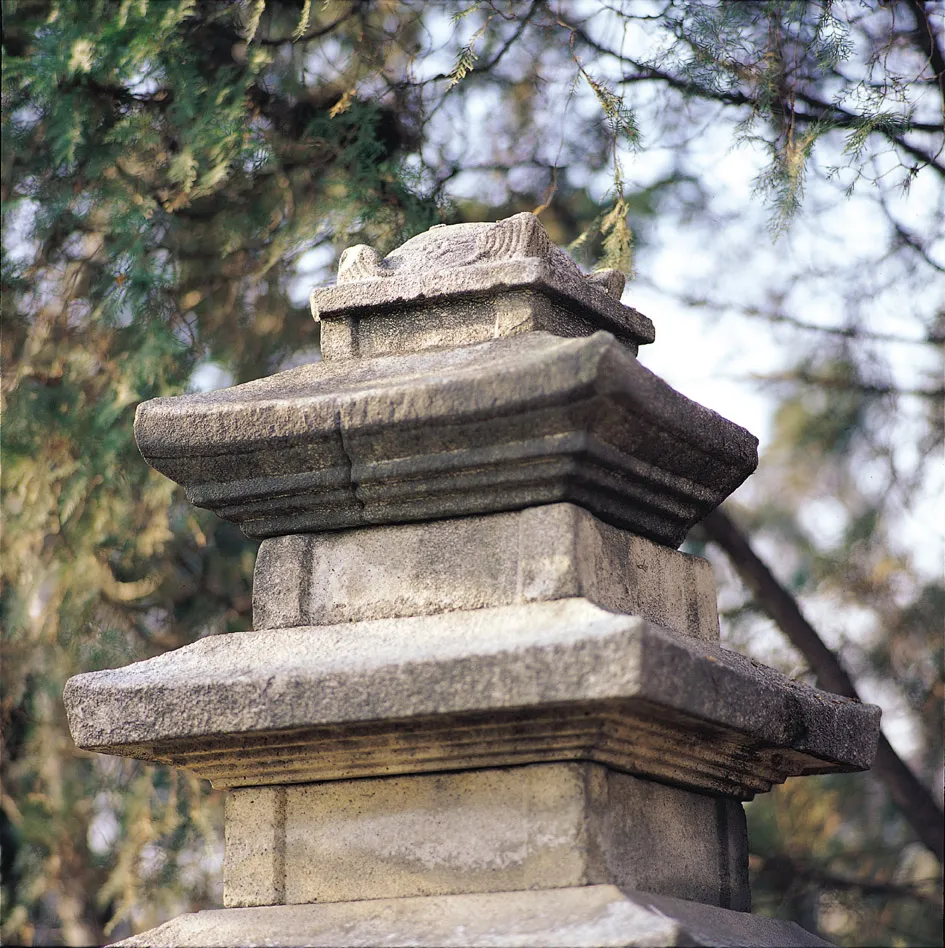
Five-story Stone Pagoda, Mungyeong
聞慶 五層石塔
서울특별시 성북구
Basic information
- Designation
- Treasure No.580
- Category
- Sites & Pagodas
- Era
- 미상
- Designated year
- 1974
- Location
- 성북구, 서울특별시— 서울 성북구 성북로 102-11, 간송미술관 (성북동)
- Coordinates
- 37.594307, 126.997083
AI Docent
Coming soonAn AI-generated, friendly retelling of this heritage site is available in Korean. An English version is on our roadmap — for now, please see the official description below.
Description
This five-story stone pagoda going back to the Goryeo Period is in the collection of the Gansong Art Museum. The pagoda was originally located in Mungyeong, Gyeongsangbuk-do and was moved during the colonial period to its current location by Jeon Hyeong-pil to prevent the Japanese from shipping it out of the country. The pagoda consists of five main levels mounted on a two-tier base, and all of its parts are preserved in a nearly intact condition. The bottom tier of the base has simple motifs that are deeply incised on all four sides, and at the top tier, a pillar-like design is placed at each corner edge and in the middle of each lateral side. The body of the pagoda consists of alternating layers of a body stone and a roof stone. The top roof stone, meanwhile, strikes the observer as slightly mismatching, as though taken from another pagoda. A pillar-like design is added at each corner edge of all five body stones. There is also a lock sculpted on the south side of the first level. The lock-shaped detail, small and carved shallowly, appears to be a simplified rendering of what was intended as a door. The sides of the roof stone are short and sharply-pitched. The roof base has a four-tier moulding at the first to fourth levels, while the moulding at the fifth level is in three tiers. The finial section consists of bokbal (an over-turned bowl-shaped decoration) on top of a square-shaped dew basin, both of them carved out of a single stone. Floral motifs are added at the four corners of the square dew basin. The distinctness of the ansang pattern at the bottom tier of the pagoda base and the uneven numbers of tiers in the moulding of the roof base suggest that this stone structure dates from the Goryeo Period. The pagoda is beautifully proportioned overall and is complete with a prayer stone, placed in front of it.
Location
지도를 불러오는 중…
Have you visited this place?
Log in and verify your visit on-site via GPS to record a stamp in My Journey. (QR verification coming later.)
Images: KOGL (khs.go.kr) · Data source: Korea Heritage Service Open API (khs.go.kr)