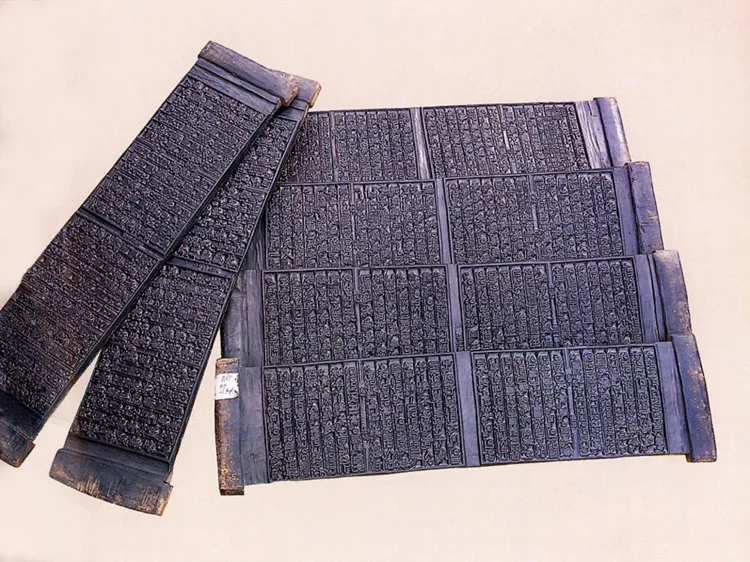
Printing Woodblocks of Worin seokbo (Episodes from the Life of Sakyamuni Buddha)
月印釋譜 木板
충청남도 공주시
Basic information
- Designation
- Treasure No.582
- Category
- Books & Records
- Era
- 조선 선조 2년(1569)
- Designated year
- 1974
- Location
- 공주시, 충청남도— 충남 공주시 계룡면 갑사로 567-3 갑사
- Coordinates
- 36.365230, 127.187250
AI Docent
Coming soonAn AI-generated, friendly retelling of this heritage site is available in Korean. An English version is on our roadmap — for now, please see the official description below.
Description
Worin seokbo is a collection of Buddhist writings, containing Worin cheongangjigok (Songs of the Moon's Reflection on a Thousand Rivers) and Seokbo sangjeol (Episodes from the Life of Sakyamuni Buddha) and was compiled in 1459 (the 5th year of King Sejo’s reign). These wood printing blocks are the only surviving printing blocks of Worin seokbo. Seokbo sangjeol was composed in 1446 (the 28th year of King Sejong’s reign), by Prince Suyang (later King Sejo) to pray for the peace of the soul of late Queen Consort Soheon, by consulting various Buddhist texts. Worin cheongangjigok, written in 1447 (the 29th year of King Sejong’s reign) by King Sejong, is a series of hymns based on the life story of Buddha, recounted in Seokbo sangjeol, with each hymn relating to every two paragraphs of the latter text. Worin seokbo is believed to have consisted of twenty four volumes (two hundred thirty-three sheets in total), but only twenty-two volumes have survived to the present. The printing blocks were carved in 1569 (the 2nd year of King Seonjo’s reign), and the project was financed by Baek Gae-man, a resident of Hansan, Chungcheong-do. The woodblocks were, thereafter, stored in Ssanggyesa Temple in Nonsan, Chungcheongnam-do. The woodblocks are said to have been brought to Gapsa Temple, its current location, some seventy years ago. The characters are carved onto laurel wood blocks in embossed carving. The names of the donor and carvers are inscribed at the bottom right of each block. The blocks are slightly defaced, with side or top dots and some of the lines of a character no longer distinguishable. These printing blocks for the first collection of Hangeul Buddhist texts published in Korea hold an inestimable value, as they offer vivid glimpses into the Korean language and script as spoken and used during the 15th century.
Location
지도를 불러오는 중…
Have you visited this place?
Log in and verify your visit on-site via GPS to record a stamp in My Journey. (QR verification coming later.)
Images: KOGL (khs.go.kr) · Data source: Korea Heritage Service Open API (khs.go.kr)