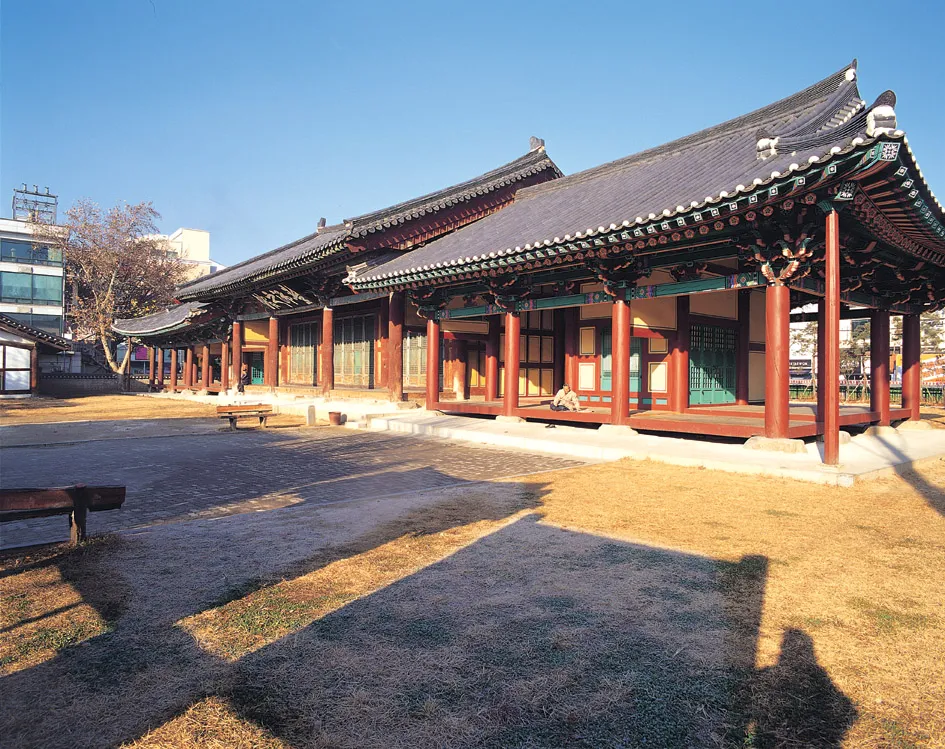
Pungpaejigwan Guesthouse, Jeonju
全州 豊沛之館
전북특별자치도 전주시
Basic information
- Designation
- Treasure No.583
- Category
- Architecture
- Era
- 조선시대
- Designated year
- 1975
- Location
- 전주시, 전북특별자치도— 전북 전주시 완산구 중앙동3가 1번지
- Coordinates
- 35.818421, 127.145297
AI Docent
Coming soonAn AI-generated, friendly retelling of this heritage site is available in Korean. An English version is on our roadmap — for now, please see the official description below.
Description
During the Goryeo and Joseon Period, a guesthouse was built in every village across the country. These guesthouses, known as gaeksa, were also referred to as gwansa or gaekgwan. Built since the early years of the Goryeo Dynasty, they were used as accommodation for foreign envoys, and banquets were held there as well. During the Joseon Period, while they were still used for the lodging of foreign envoys, various memorial tablets were also housed there. Meanwhile, on the first and fifteenth day of every month, ceremonies were held, facing the direction of the royal palace, to pay respects to the royal house. In those guesthouses in areas along the route to and from China, building repairs were apparently no small chores, since they received high-profile guests like Joseon’s state envoys to the Ming Dynasty and Ming-dynasty envoy to Joseon. Also, when there was a major event in the country, people held rites in the guesthouses, together with their town officials. Judging from the record stating that Seouiheon was re-built in 1471 (the 2nd year of King Seongjong’s reign), using materials left over from the construction of Jeonju Library, Pungpaejigwan appears to pre-date this building. The front gate of the guesthouse faces the main building. The guesthouse originally had three triple gates - inner, middle and outer gates -. Today, however, only the inner gate has survived with the building compound reduced to the area inside this gate. The guesthouse has a gamsil, a room where memorial tablets are held. Memorial tablets in this place bear the character ‘gwol (闕),” engraved on it. Respects were paid to the king through a rite called “manggwollye,” and state envoys staying here at times carried the king’s messages or orders to the local administration. Of the many buildings that once stood on its grounds, including the east and west Ikheon, Maengcheong and Musinsa, only the east and west Ikheon and Sujiksa remain today. The east Ikheon, originally identical in appearance to the west Ikheon, was partially truncated due to the construction of a road linking the north and south gates during the colonial period. In 1999, when the building was rebuilt, only cornerstones had survived from the original structure. The name “Pungpaejigwan” is visible on a tablet hung at the front of the main building. This name signifies that Jeonju is the place of origin of Joseon’s royal house.
Location
지도를 불러오는 중…
Have you visited this place?
Log in and verify your visit on-site via GPS to record a stamp in My Journey. (QR verification coming later.)
Images: KOGL (khs.go.kr) · Data source: Korea Heritage Service Open API (khs.go.kr)