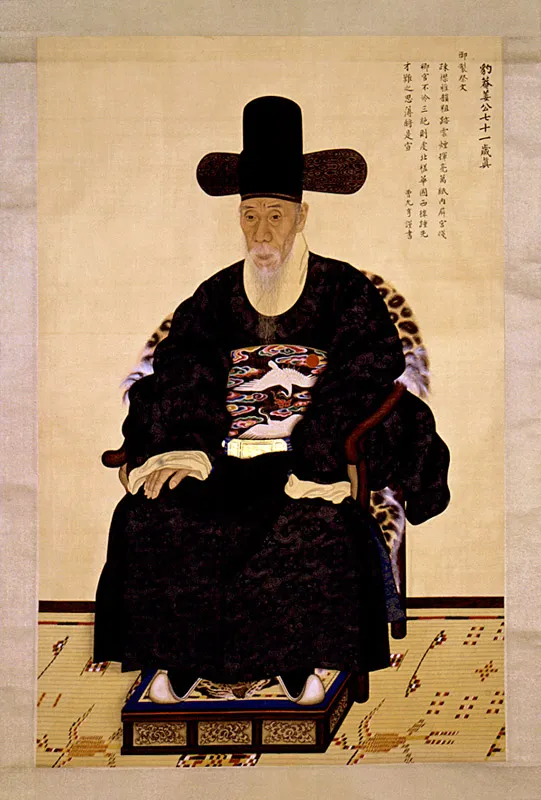
Portrait of Kang Se-hwang
姜世晃 肖像
서울특별시 용산구
Basic information
- Designation
- Treasure No.590
- Category
- Painting
- Era
- 조선 정조 6, 7년
- Designated year
- 1975
- Location
- 용산구, 서울특별시— 서울특별시 용산구 서빙고로 137 (용산동6가, 국립중앙박물관)
- Coordinates
- 37.524041, 126.980350
AI Docent
Coming soonAn AI-generated, friendly retelling of this heritage site is available in Korean. An English version is on our roadmap — for now, please see the official description below.
Description
These two portraits are of Kang Se-hwang (1713-1791), a renowned literati painter-calligrapher of late Joseon. One of them is a self-portrait painted by Kang Se-hwang, and the other is attributed to Yi Myeong-gi. The self-portrait is 51㎝ by 88.7㎝, and the other portrait 94㎝ by 145.5㎝. Both are ink and color works, realized on silk. As a painter, Kang Se-hwang, who was also an accomplished poet and calligrapher, had a uniquely recognizable style. In the self-portrait, Kang Se-hwang depicted himself wearing a black court official’s hat and a dopo coat in dark jade color. In the portrait attributed to Yi Myeong-gi, he dons a court official’s costume, along with a matching hat. Kang Se-hwang is shown in three-quarter view and looks to his right in both portraits. Both are seated full-length portraits. Wrinkles and lines on the face are rendered by an extra-touch of paint, and shadows are added in depressed areas to translate depth. The self-portrait represents Kang Se-hwang at the age of seventy-one. The other portrait by Yi Myeong-gi, a reputed portrait artist, was painted after Kang Se-hwang’s death, based on this self-portrait, although he is shown in different clothes. This portrait depicts small details such as knuckles in the fingers, something almost never seen in early-Joseon portraits, and is, therefore, a testament to changes that are meaningful for the history of Joseon painting.
Location
지도를 불러오는 중…
Have you visited this place?
Log in and verify your visit on-site via GPS to record a stamp in My Journey. (QR verification coming later.)
Images: KOGL (khs.go.kr) · Data source: Korea Heritage Service Open API (khs.go.kr)