Donghwasa Mokjoyaksayeoraejwasang Reliquary Documents, Daegu
大邱 桐華寺 木造藥師如來坐像 腹藏典籍
대구광역시 동구
Basic information
- Designation
- Treasure No.1607
- Category
- Books & Records
- Era
- 12~15세기
- Designated year
- 2009
- Location
- 동구, 대구광역시— 대구광역시 동구 동화사1길 1 (도학동)
- Coordinates
- 35.993304, 128.703690
AI Docent
Coming soonAn AI-generated, friendly retelling of this heritage site is available in Korean. An English version is on our roadmap — for now, please see the official description below.
Description
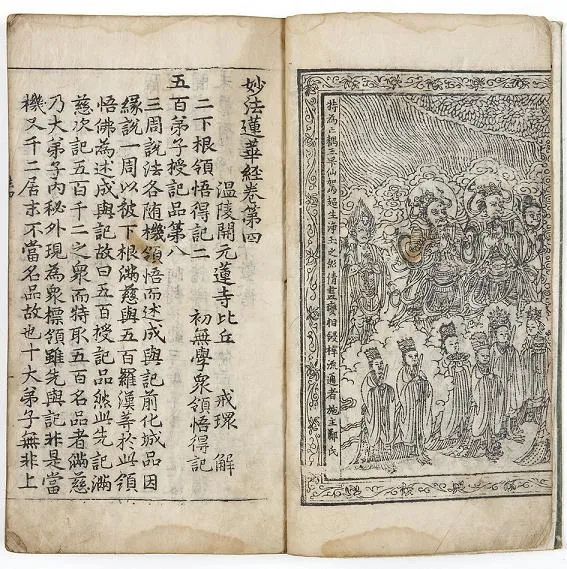
This is an ensemble of seven Buddhist scriptures found inside the Bhaisajyaguru Buddha statue in Daeungjeon Hall of Donghwasa Temple in Daegu, one of the three seated wooden Buddha statues housed in the same place. Daeungjeon Hall was rebuilt in 1725 (the first year of King Yeongjo’s reign), and two years later in 1727 (the third year of King Yeongjo’s reign), statues representing the Buddhas of Three Ages were created and housed there. The seven Buddhist sutras were placed inside the three statues at this time, along with prayer scrolls. The Sakyamuni Buddha statue contained twelve texts and objects, and six statues of Amitabha Buddha. The Bhaisajyaguru Buddha statue contained the largest quantity of texts and objects, thirty-two in total number. Texts with publishing information date from 1417 (the 17th year of King Taejong’s reign) to 1725, and those without publishing information appear to date from mid-Goryeo to late Joseon while most of them are from prior to the date of creation of the Bhaisajyaguru Buddha statue. The Saddharmapundarika Sutra (The Lotus Sutra), found inside the wooden Bhaisajyaguru Buddha statue, consisting of the fourth to seventh volumes, is one of four copies printed in 1417, under the patronage of Lady Park, wife of Prince Hamyang, who thus hoped to implore Buddha’s mercy for the souls of her late parents. At the left bottom of the illustration at the beginning of the fourth volume, there is a note explaining the circumstances of creation of this illustration, stating that woodcut illustrations based on a painting by a painter hired by a certain Lady Jeong were distributed in prayer for the rebirth of her late husband in Paradise. This sutra is of significance for understanding private Buddhist faith-based practices in early Joseon and for bibliographic research into this period. As for Ksitigarbha pranidhana Sutra (Great Vows of Ksitigarbha Bodhisattva), according to the postscript and the accompanying ink written note, it is one of seven copies of a version published in 1474 (the fifth year of King Seongjong’s reign) in Gyeonseongsa Temple, printed in 1481 (the 12th year of King Seongjong’s reign), under the patronage of Queen Consort Insun (Lady Han), second wife of King Yejong who thus wished for the peace of the soul of her late grandmother Lady Kim, wife of Sin Suk-hwa. This sutra, considered invaluable for research into the history of early Joseon Buddhism, is of high importance also because the year in which it was printed is precisely known, as well as the number of copies printed and the circumstances surrounding its printing. Volume 1 of the Zhenyuan Version of Avatamsaka Sutra (The Flower Garland Sutra) and Volumes 25 and 63 of the Zhou Version of the same sutra consist twenty-four total lines of seventeen characters in folded sheets, each containing six lines. This selection from the Avatamsaka Sutra is the version printed in Haeinsa Temple. This version of the Avatamsaka Sutra was one of the base texts for carving Tripitaka Koreana blocks, and blocks for the former are believed to have been carved as early as in the 12th-13thcentury. The second volume of Anuttarasraya Sutra written in silver on oak paper and the 94th volume of Maharatnakuta Sutra (Sutra of the Great Accumulation of Treasures) written in silver on oak paper are sutras that were hand-copied in silver, dating from the 14th century, and are valued for the insights they offer into hand-copied sutras of late Goryeo.
Location
지도를 불러오는 중…
Have you visited this place?
Log in and verify your visit on-site via GPS to record a stamp in My Journey. (QR verification coming later.)
Images: KOGL (khs.go.kr) · Data source: Korea Heritage Service Open API (khs.go.kr)