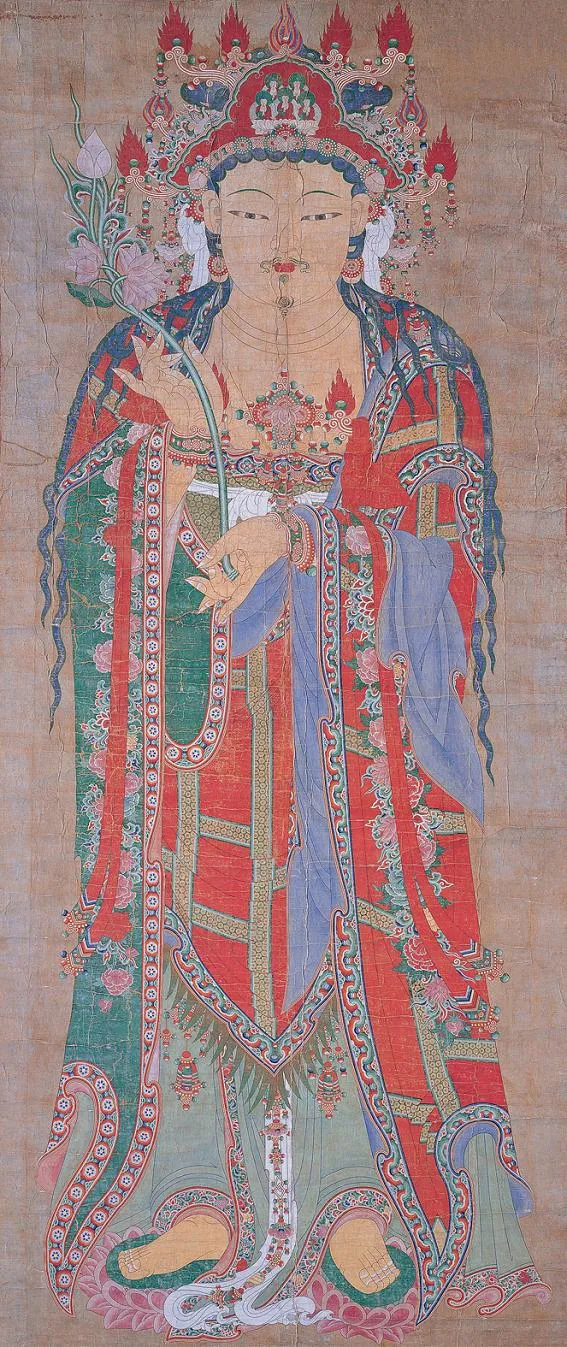
Bogyeongsa Hanging Buddhist Painting (Gwaebultaeng), Pohang
浦項 寶鏡寺 掛佛幀
경상북도 포항시
Basic information
- Designation
- Treasure No.1609
- Category
- Painting
- Designated year
- 2009
- Location
- 포항시, 경상북도— 경상북도 포항시 북구 보경로 523 (송라면, 보경사)
- Coordinates
- 36.228854, 129.356944
AI Docent
Coming soonAn AI-generated, friendly retelling of this heritage site is available in Korean. An English version is on our roadmap — for now, please see the official description below.
Description
The Buddhist painting of Bogyeongsa Temple, originally created in 1708 (the 34th year of King Sukjong’s reign), was re-painted seventeen years later, in 1725 (the first year of King Yeongjo’s reign). It was a collaborative work by a group of painters based in Gyeongsang-do, including Uigyun, Seokmin, Seongik, Jibung, Chehwan, Kwaemin and Samhak. These same painters also took part in the creation of Buddhist paintings housed in Donghwasa Temple and Pagyesa Temple in Palgongsan Mountain, Daegu. This gigantic Buddhist painting, nearly 10m on the longest side, portrays a Bodhisattva-style Buddha, holding a lotus stem, unaccompanied by attendant Buddhas. This work is considered the greatest masterpiece of Uigyun. In spite of a very simple composition portraying an unattended Buddha in an oversized sheet, the Buddhist painting impresses with outstanding combinations of similar and contrasting colors, mostly in red, green and blue tones, and displays intricate details such as green design motifs on the gold-painted sash of Buddha’s robe and fine motifs at the bottom edge of the robe .Buddhas wearing a sumptuous jewel crown, decorated with the sculptures of five Buddhas and holding a lotus stem like the Buddha in the Hanging Painting of Bogyeongsa Temple were popularly portrayed in Buddhist paintings produced in the Gyeongsang-do region, between the late 17th century and the early 18th century. As a work with iconographic details that are associated with a specific period of time and region, this painting can cast important light on the history and evolution of Joseon Buddhist paintings.
Location
지도를 불러오는 중…
Have you visited this place?
Log in and verify your visit on-site via GPS to record a stamp in My Journey. (QR verification coming later.)
Images: KOGL (khs.go.kr) · Data source: Korea Heritage Service Open API (khs.go.kr)