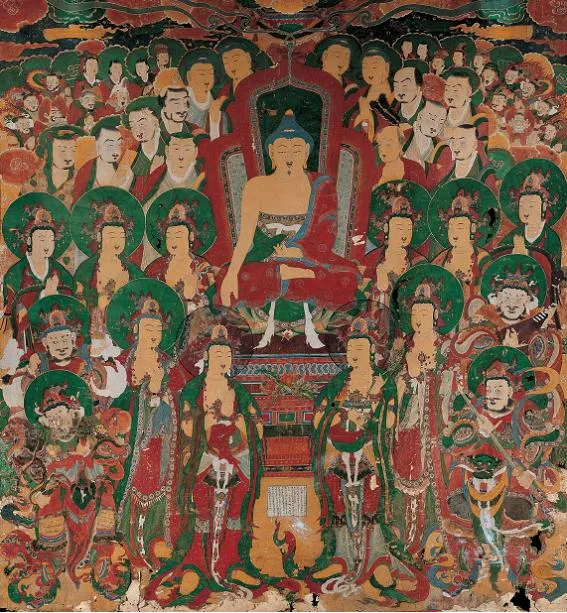
Bongrimsa Yeongsanhoesangdo Mit Reliquary Objects, Yeongcheon
永川 鳳林寺 靈山會上圖 및 腹藏遺物
경상북도 영천시
Basic information
- Designation
- Treasure No.1612
- Category
- Painting
- Era
- 1724년
- Designated year
- 2009
- Location
- 영천시, 경상북도— 경북 영천시 화북면 천문로 2149-368, 봉림사 (자천리)
- Coordinates
- 36.126008, 128.897830
AI Docent
Coming soonAn AI-generated, friendly retelling of this heritage site is available in Korean. An English version is on our roadmap — for now, please see the official description below.
Description
This Buddhist painting, dating from 1724, is by Kwaemin and Chejun. Kwaemin was a disciple of Uigyun, a monk painter of renown who was active between the late 17th century and the early 18th century in the Palgongsan Mountain area. It depicts the scene of Sakyamuni Buddha’s sermon on Vulture Peak in a typical style of a painting featuring a large Buddhist pantheon. The painting is crowded with a large cohort of Bodhisattvas, disciples and Divine Guardians of the Dharma, surrounding Sakyamuni Buddha in the middle. The main Buddha has a tall rectangular-shaped halo around his head and a pointed ushnisha on top of the head. The figures are depicted in such a way as to convey a strong feeling of volume and depth. The way the bodies of the Four Guardian Kings are depicted, in particular, is reminiscent of the Painting of Vairocana Buddha Triad preaching to the assembly in Girimsa Temple, painted by Kwaemin’s mentor, Uigyun. At the same time, the use of colors, notably the sharply contrasting combination of red and green, and the composition, in which the painting is densely packed with the retinue of the main Buddha, are two aspects which distinguish Kwaemin from his teacher. These characteristics, insofar as they were part of a leading trend in Buddhist paintings, seen starting in 1728, add further significance to this work. The painting, furthermore, has not only a postscript and a prayer text, but is also accompanied by a votive object pouch, appropriately furnished with a container; all these provide priceless information on the circumstances of its creation.
Location
지도를 불러오는 중…
Have you visited this place?
Log in and verify your visit on-site via GPS to record a stamp in My Journey. (QR verification coming later.)
Images: KOGL (khs.go.kr) · Data source: Korea Heritage Service Open API (khs.go.kr)