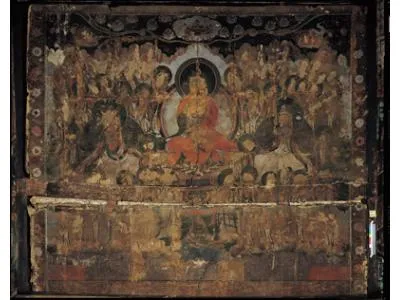
Bongjeongsa Yeongsanhoesang Mural Painting, Andong
安東 鳳停寺 靈山會上壁畵
경상북도 안동시
Basic information
- Designation
- Treasure No.1614
- Category
- Painting
- Era
- 1435년경
- Designated year
- 2009
- Location
- 안동시, 경상북도— 경북 안동시 서후면 봉정사길 222, 봉정사 (태장리)
- Coordinates
- 36.653265, 128.662533
AI Docent
Coming soonAn AI-generated, friendly retelling of this heritage site is available in Korean. An English version is on our roadmap — for now, please see the official description below.
Description
This mural painting was discovered on January 16, 1997, and after conservation treatment, was placed in the museum inside the precincts of Bongjeongsa Temple where it still is today. The mural is crackled in places, due to the distortion of the horizontal wood bar at the mid-level of the wall, and has also suffered extensive damage, from both natural causes and human sources. Much of its original appearance has therefore been lost, and aside from the general composition and colors, only some of the decorative motifs can be made out. The mural represents Buddha with his hands in the vitarka mudra, surrounded by several attendants. From the information provided in the note, still legible, one learns that the scene represented is that of Sakyamuni Buddha preaching on Vulture Peak. The mural has a heavy feel about it, due to a somber color tone, having red and green as the two dominant colors. But, these colors form a nice contrast with the light blue and pale pink containing large amounts of chalk, used for the main Buddha’s crimson robe, creating a solemn and majestic atmosphere. The date of creation of this mural cannot be precisely determined. But, based on the repair record for Daeungjeon Hall, dating from 1435, which was discovered above a beam bracket during the disassembling of the building for a repair, and the inscription on a façade column, written in ink, dating from 1436, the mural is likely to have been painted in around 1435. The Mural Painting of Bongjeongsa Temple is, therefore, the oldest surviving painting of the Vulture Peak Assembly. One of the two major examples of early Joseon Buddhist paintings, along with the Mural Painting of Amitabha Buddha in Geungnakjeon Hall of Muwisa Temple in Gangjin (1476), this work is also of high significance as the prototype of other paintings depicting the same scene from subsequent eras, featuring large Buddhist pantheons.
Location
지도를 불러오는 중…
Have you visited this place?
Log in and verify your visit on-site via GPS to record a stamp in My Journey. (QR verification coming later.)
Images: KOGL (khs.go.kr) · Data source: Korea Heritage Service Open API (khs.go.kr)