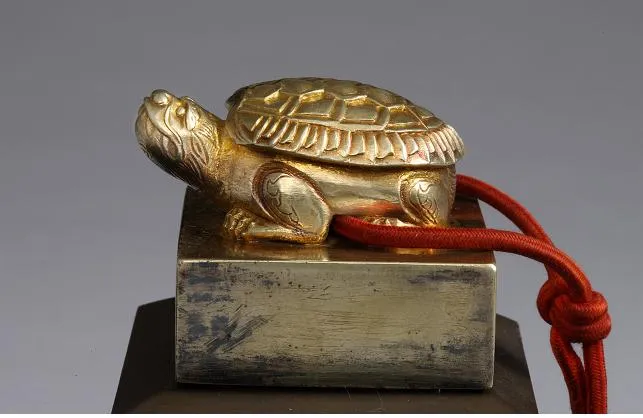
Daehanjeguk Gojong Hwangjeeosae
大韓帝國 高宗 皇帝御璽
서울특별시 종로구
Basic information
- Designation
- Treasure No.1618-1
- Category
- Craft
- Designated year
- 2009
- Location
- 종로구, 서울특별시— 서울 종로구 효자로 12, 국립고궁박물관 (세종로,국립고궁박물관)
- Coordinates
- 37.576592, 126.974975Kakao address conversion
AI Docent
Coming soonAn AI-generated, friendly retelling of this heritage site is available in Korean. An English version is on our roadmap — for now, please see the official description below.
Description
In October 1897, Emperor Gojong, the 26th ruler of Joseon, proclaimed the country an empire, to bring its status to a par with neighboring Qing China and Japan, and in an attempt to find a new balance in its relations with these countries in a turbulent time. ‘Gwangmu,’ borrowed from the name of Later Han emperor Gwangmu (Guangwu in Chinese), was chosen as the imperial era name, and the idea behind it was that Joseon was succeeded by the Korean Empire, in the same way as the Han Dynasty was succeeded by the Later Han. Following the re-proclamation of Joseon as the Korean Empire, all official seals were replaced by new ones befitting the new imperial status of the country and its ruler. The details of this event are related in Boin busin chongsu (Comprehensive Inventory of Seals and Stamps) which has survived to the present from this period. The imperial seal in the collection of the National Palace Museum of Korea, however, is not listed in the above inventory, and its authenticity is, therefore, open to debate. Also, unlike most imperial seals of the Korean Empire, which measure about 10cm by 10cm in face dimension, rarely less than 9cm by 9cm with larger ones measuring up to 12cm by 12cm, this seal is only 5.3cm by 5.3cm; another detail that raises doubts about its authenticity. That said, given how the Korean Empire was on the brink of becoming occupied by foreign powers throughout its short existence and the types of documents for which this imperial seal was used (listed below), the atypical appearance of the seal can very well be explained by the fact that it was carved under special circumstances in which Emperor Gojong’s seal could not be openly used. This is also probably why the seal was not listed in Boin busin chongsu, and why it is significantly smaller in size than others and was stored in a case, together with the ink pad. Documents bearing the imperial seal of the National Palace Museum of Korea (1) Secret letter to the Russian Emperor sent on August 15, 1903 (7th Gwangmu year); (2) Letter to the Italian Emperor, sent on November 23, 1903; (3) Letter to the Russian Emperor, sent on July 1, 1904; (4) Letter to the Russian Emperor, sent on September 6, 1904; (5) Letter to the Russian Emperor, sent on November 20, 1904; (6) Letter to the Russian Emperor, secretly sent on January 10, 1905; (7) Letter to the Russian Emperor, sent on April 3, 1905’ (8) Letter to Horace Newton Allen, US Legate to Korean Empire, sent on November 18, 1905; (9) Letter to the German Emperor, sent in January 1906;(10) Letter to Homer Hulbert, empowering him as a special envoy carrying Korean’s letter, sent on June 22, 1906;(11) Letters to the heads of state of the five countries with which the Korean Empire signed a treaty (Russia, Italy, France, Austria-Hungary, Germany), sent on June 22, 1906 (5 letters);(12) Letter to the French President, sent on November 1, 1906;(13) Letter to the Russian Emperor, secretly sent on April 20, 1907;(14) Letter to Homer Hulbert, sent on January 1, 1909, in which Emperor Gojong asks the American missionary to look after his nephew studying in the US (Jo Nam-bok);(15) Power of attorney sent to Homer Hulbert on October 20, 1909 to have the latter withdraw funds the royal house had deposited with a German bank in Shanghai. As can be seen in the above list, this seal was used mostly for diplomatic missives secretly sent by Emperor Gojong to foreign heads of state, although (14) and (15) are letters sent to Homer Hulbert in regard to personal businesses. Except (14), all other letters in this list are available in Korea, only in the form of a photo or photocopy, as their originals are held in overseas institutions. The imperial seal in the collection of the National Palace Museum of Korea was compared with the seal on each of these letters and was found to exactly match them. Emperor Gojong continued to carry this seal, used mainly to ask other heads of state for assistance in the run-up to the annexation of Korea by Japan, to stay the latter’s Imperialist ambitions, even after he was deposed from the throne, after which he used it for private purposes. Toward August 1903, on the eve of the Russo-Japanese War, Emperor Gojong engaged in secret diplomatic activities to rescue his country from Japan’s grip and needed a new imperial seal to verify the genuineness of messages sent to other heads of state. In order to keep complete secrecy, Emperor Gojong personally kept and used the seal, without going through the customary court procedures involving his ministers to seal a letter. Therefore, the size of the seal had to be small enough to be conveniently hidden away in a secret location. Also of note is the fact that Emperor Gojong established a secret intelligence agency directly reporting to him, in June 1902, baptizing it “Jegugikmunsa (Imperial News Agency).” According to ‘Jegugikmunsa Bibojangjeong (Secret Manual of Jegukikmunsa)’ in the Jangseokgak Library of the Academy of Korean Studies, this Hanseong (today’s Seoul)-based intelligence agency, disguised as a news agency, had sixty-one agents and nine agents stationed overseas, in places like Tokyo, Osaka, Nagasaki, Beijing, Vladivostok and Lushun (see Lee, Tae-jin, ‘Ikmunsa, Emperor Gojong’s Intelligence Bureau and a Pillar in His Anti-Japanese Struggle,’ in Gojong sidae ui jaejomyeong (Revisiting Emperor Gojong’s Reign), Seoul: Taehaksa, 2000). Missives sent from Emperor Gojong to foreign heads of state are, therefore, likely to have been carried by the agents of Jegugikmunsa. The fact, for example, that this agency was in operation for about a one-year period, which begins and ends roughly at the same time as the first and last letters bearing the seal in the collection of the National Palace Museum, lends support to this conjecture. This seal of Emperor Gojong, as an artifact bearing testimony to the efforts by the last ruler of Korea’s last dynasty to defend his country from the threat of becoming an occupied country by Japan, has an immeasurable historical significance, amply deserving the designation as a cultural heritage object.
Location
지도를 불러오는 중…
Have you visited this place?
Log in and verify your visit on-site via GPS to record a stamp in My Journey. (QR verification coming later.)
Images: KOGL (khs.go.kr) · Data source: Korea Heritage Service Open API (khs.go.kr)