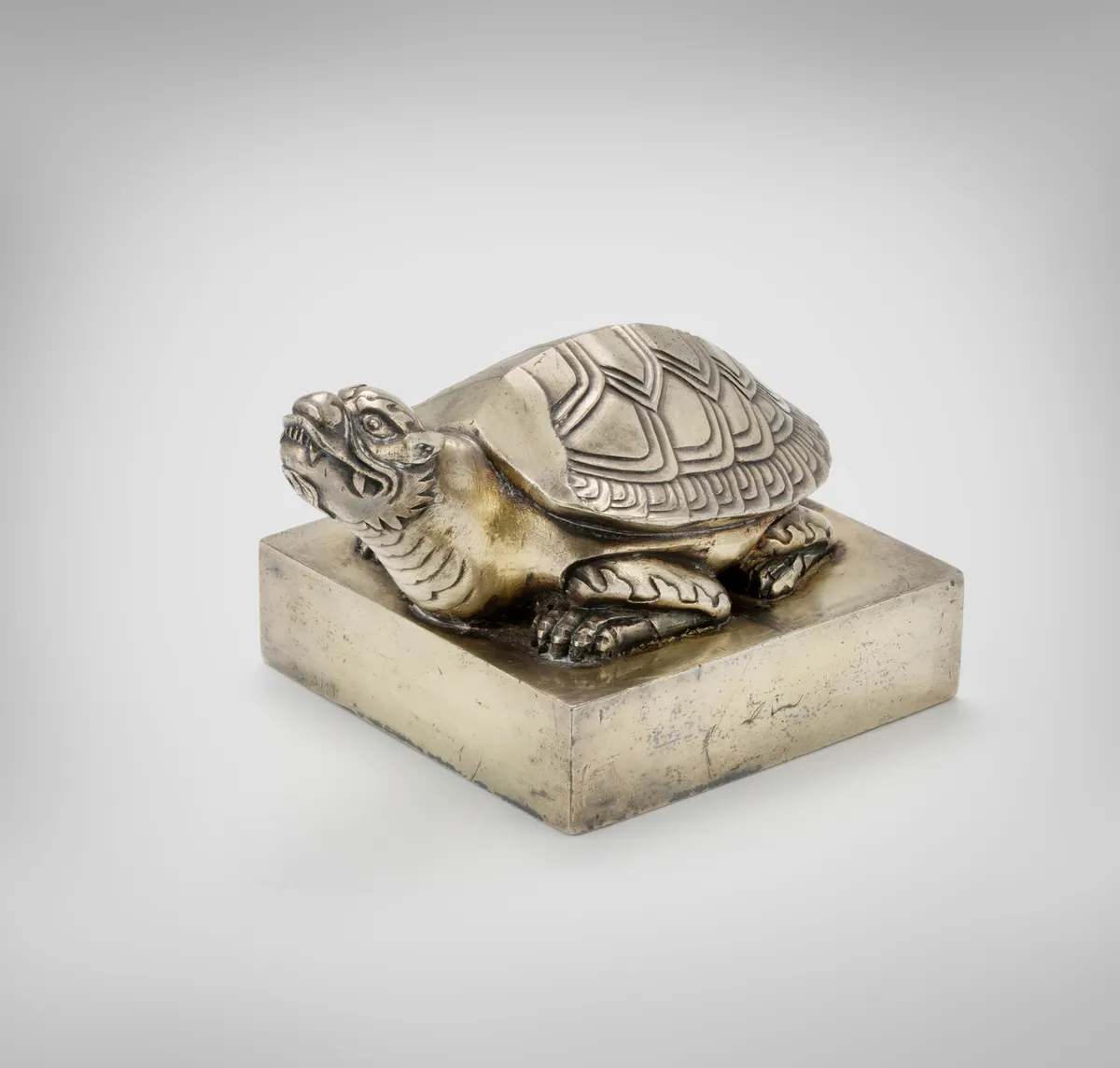
Guksae Daegunjubo
國璽 大君主寶
서울특별시 종로구
Basic information
- Designation
- Treasure No.1618-5
- Category
- Books & Records
- Era
- 1882년(고종 19)
- Designated year
- 2021
- Location
- 종로구, 서울특별시— 서울특별시 종로구
- Coordinates
- 37.574773, 126.979614
AI Docent
Coming soonAn AI-generated, friendly retelling of this heritage site is available in Korean. An English version is on our roadmap — for now, please see the official description below.
Description
Machine-translatedThis English description was machine-translated and may contain inaccuracies. Refer to the original Korean text for details.
The National Seal 'Daegunjubo' (Great Lord's Seal) was commissioned in 1882 as one of six copies to accompany the national flag for the ratification of the Korean-American Treaty, completed on July 1, 1882, by the Muwiyeong (Military Escort Camp), the palace guard bureau of King Gojong's era, with budgetary support from the Finance Ministry. This represents the sole surviving example known to date. Serving as the national seal for diplomatic purposes, official appointments, and edicts issued under the Great Lord's authority, the seal was recovered from the United States in February 2020 and is currently preserved at the National Palace Museum. The Daegunjubo's form, material, and dimensions correspond precisely to those documented in the Guarantee Seals and Symbols Record, while the Gojong Imperial Annals provide confirmation of its manufacturing background, timing, and location, making it an artifact verified through written records. The seal features a turtle-shaped handle knob with the seal face inscribed in nine-fold seal script with characters signifying 'Great Joseon's Great Lord.' Examination of the turtle-shaped knob reveals the characteristic form with the turtle comprising the handle mechanism. The seal face displays characters engraved in nine-fold seal script. The Daegunjubo functioned as the national seal through which King Gojong asserted national sovereignty during the period surrounding the Gapohgeumyung (1884 Reform) and its aftermath, employed on ratified documents and official papers representing the aspiring independent nation. Subsequently, in October 1897 when King Gojong ascended to the imperial throne at the Wongudan altar, changing the nation's name from Joseon to the Korean Empire, the seal was replaced with the 'Daehan National Seal' (Great Han National Seal). Thereafter, beginning January 1899 when the Korean Empire formally adopted the new seal, the Daegunjubo ceased usage. This artifact symbolically represents the international situation changes and Joseon's corresponding diplomatic responses surrounding the 1884 Reform period. It remains the sole known artifact preserving the pre-Korean Empire national seal manufacturing methods of King Gojong's era, encompassing calligraphy style, knob design, materials, and casting techniques.
Location
지도를 불러오는 중…
Have you visited this place?
Log in and verify your visit on-site via GPS to record a stamp in My Journey. (QR verification coming later.)
Images: KOGL (khs.go.kr) · Data source: Korea Heritage Service Open API (khs.go.kr)