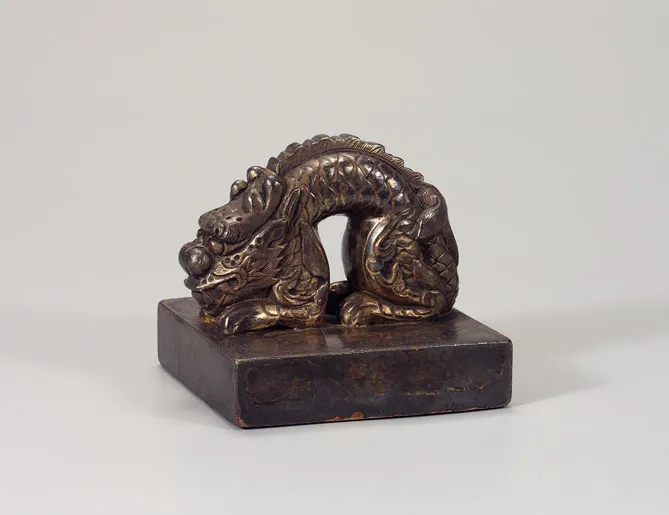
Guksae Chikmyeongjibo
國璽 勅命之寶
서울특별시 용산구
Basic information
- Designation
- Treasure No.1618-7
- Category
- Books & Records
- Era
- 1898년(광무2)
- Designated year
- 2021
- Location
- 용산구, 서울특별시— 서울특별시 용산구 서빙고로 137 (용산동6가, 국립중앙박물관)
- Coordinates
- 37.524067, 126.980688Kakao address conversion
AI Docent
Coming soonAn AI-generated, friendly retelling of this heritage site is available in Korean. An English version is on our roadmap — for now, please see the official description below.
Description
Machine-translatedThis English description was machine-translated and may contain inaccuracies. Refer to the original Korean text for details.
The National Seal 'Chiknyeong Jibo' (Imperial Edict Seal) was created in 1898, specifically on the nineteenth day of the third lunar month, distinct from the 1897 September version, as one of ten Korean Empire national seals established when King Gojong proclaimed the empire and ascended as emperor. The 1946 repatriation occurred when the U.S. Military Administration transferred it to the Government-General Bureau, subsequently moved to the National Central Museum on June 28, 1954, where it remains in curatorial management. Manufacturing processes are documented in the Great Ceremony Ritual Manual from 1897 detailing Gojong's imperial proclamation and ascension, with the Imperial Seal Symbol Record recording the seal's characteristics, materials, and actual usage examples. The Chiknyeong Jibo comprises a dragon-shaped handle knob and seal body. The seal body measures three chi three bun (9.08×9.12cm), relatively smaller compared to the 1897 Chiknyeong Jibo (measuring four chi one bun). The handle features dragon-shaped design with jade antlers protruding from the crown, dot patterns on the apex, auspicious cloud designs on the nose, opened mouth with two protruding lower teeth, surrounding auspicious vapor, and a held precious orb. The entire body is covered with scales creating a semicircular arch on the back. The calligraphy employs small-seal script, the same as other Korean Empire seals, with uniform characters in bilateral symmetrical arrangement, presenting refined form symbolizing imperial majesty's austere authority. The Chiknyeong Jibo, as a Korean Empire national seal, allows complete confirmation of manufacturing processes through documentary sources and diverse practical applications, preserving its original form entirely as a historical symbol embodying the nation's shared fate and tribulations.
Location
지도를 불러오는 중…
Have you visited this place?
Log in and verify your visit on-site via GPS to record a stamp in My Journey. (QR verification coming later.)
Images: KOGL (khs.go.kr) · Data source: Korea Heritage Service Open API (khs.go.kr)